
A tough summer for trees
by Clare Graham, Chair, Open Spaces Committee
Four heatwaves and a prolonged period of drought have made the summer of 2026 a difficult time for Battersea's trees, both old and young.
Changing Landscapes
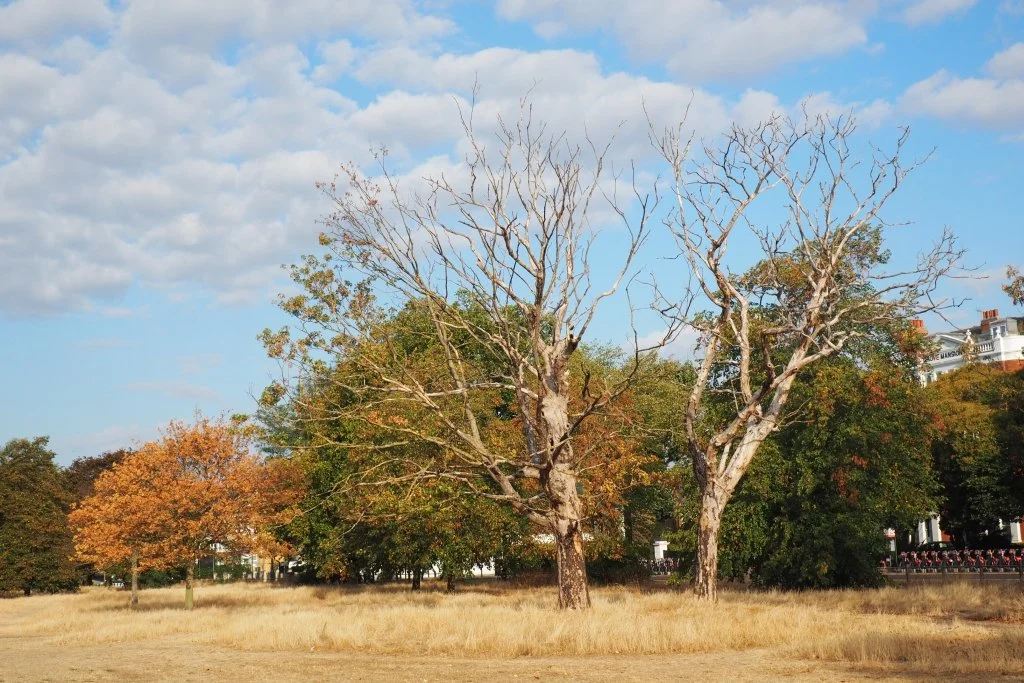
Stressed trees on Clapham Common. All photos © the author.
After a prolonged period of drought and no fewer than four heatwaves, our local open spaces are looking brown and sad. The grass is in some places beginning to grow back again, encouraged by a little rain. But on my walks around local streets and open spaces, I can see a discouraging number of very stressed-looking mature trees. I was particularly struck by a large group on the Battersea side of Clapham Common beside North Side, some of which are shown above. When I asked Gareth James of Wild Clapham, the charity behind the various recent biodiversity projects on the Common, about them he told me: I’m afraid many of the mature trees and heritage trees on Clapham Common have been seriously affected by the drought and the heat this year.... North Side has been particularly badly affected and the news is increasingly worrying for future years. Kew Gardens lost 400 trees in 2022 during the drought and 40°C temperatures (compared to their average annual loss of 30 trees). They are predicting that over 50% of their trees will be stretched up to, and beyond, their climate tolerance by 2090 and the landscape across the whole of the southeast of England is set to change....Kew’s Landscape Succession report (2024) identified a number of species that are highly vulnerable to climate change. These include; silver birch, oak, beech, holly, rowan and cherry. These trees will start to disappear from the landscape in the coming years. We are already trialling more drought resistant trees species on the Common and we are considering other options as well but do brace yourself - it’s going to be a bumpy ride.
Sobering reading, for sure. Some of these individual trees are not beyond the point of recovery, I would hope, if we get all the rainfall we are going to need this winter to replenish London's dry ground. Note too that trees, like us, have a natural lifespan. Those nearing the end of that are likely to be the first to go, having become less resilient to the challenge of extreme weather; hence the sad loss of such veteran trees as the Major Oak this summer. But rather than descend into total doom and gloom I will point you to a 2025 report on future-proofing London's public realm trees. Building on the research mentioned by Gareth, and commissioned by the Greater London Authority and the Forestry Commission, this shows how data modelling, climate projections, and plant biology can all be used to help keep London green and shady going forward.
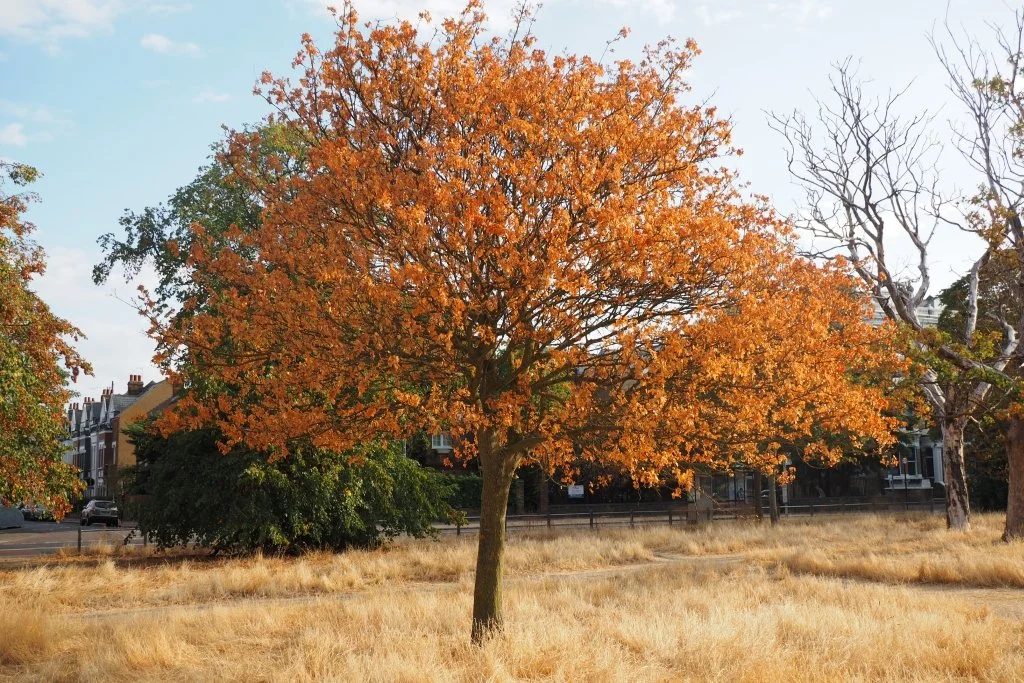
Close-up of one of the stressed trees on Clapham Common.
Tree Establishment
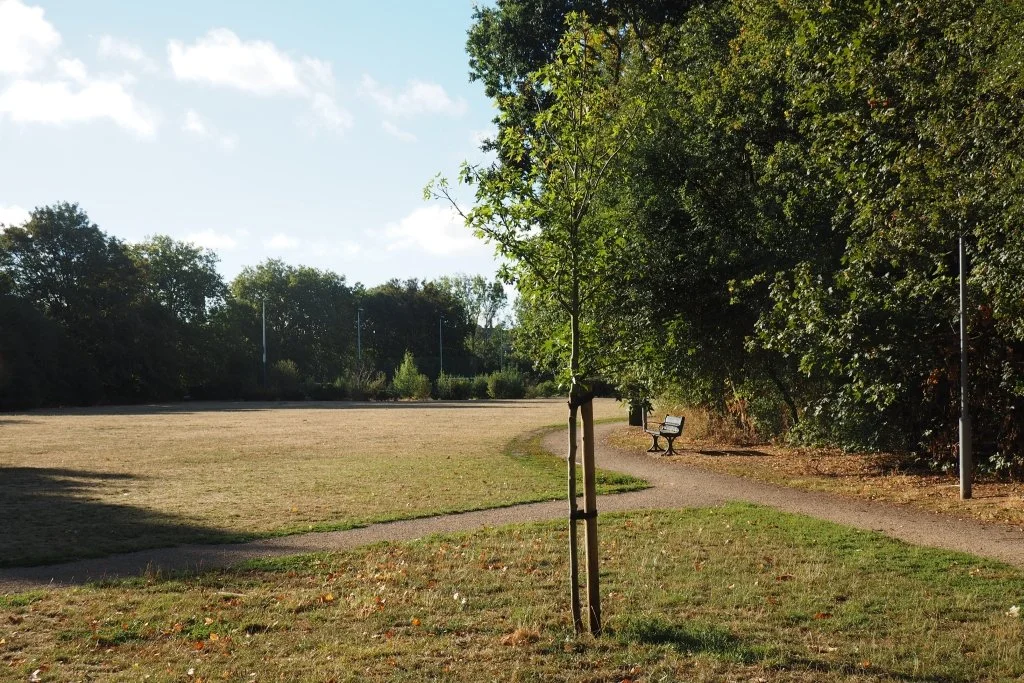
The Battersea Society Coronation Year Tree in Falcon Park
A young tree is best planted in autumn and winter, which gives it time to dig in its roots before it starts into growth in the spring. Once it is growing, it will need extra water until it is 'established', i.e. has grown a root system large and strong enough to cope on its own. Traditionally Wandsworth Council watered its trees for their first year, then thanks to climate change that got upped to two, and now a young tree will be watered for its first three years if the weather requires it. But of course even a healthy young established tree will have felt the impact of this summer's extreme weather; I was certainly worried earlier this year about our Coronation Year liquidambar in Falcon Park, planted at the end of 2023. In May and June this began to look very shrivelled; happily it is now looking much more vigorous again, though predictably it has put on little growth this year, and dead twig-tips and blackened seed pods bear witness to that earlier struggle.
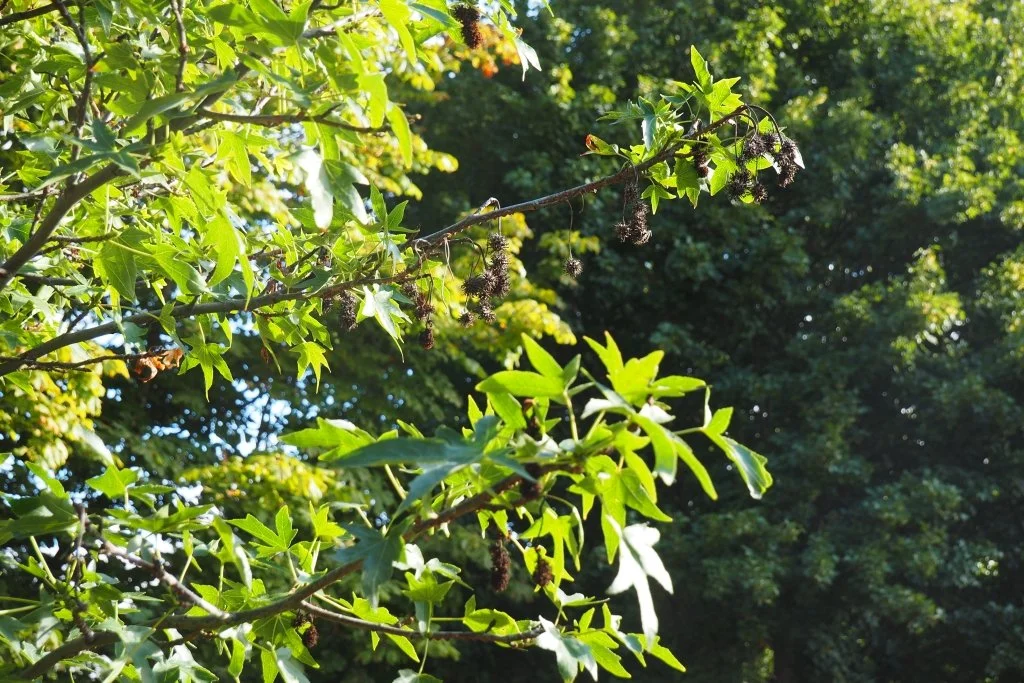
The Coronation Year Tree: a close-up.
2026 Watering Issues
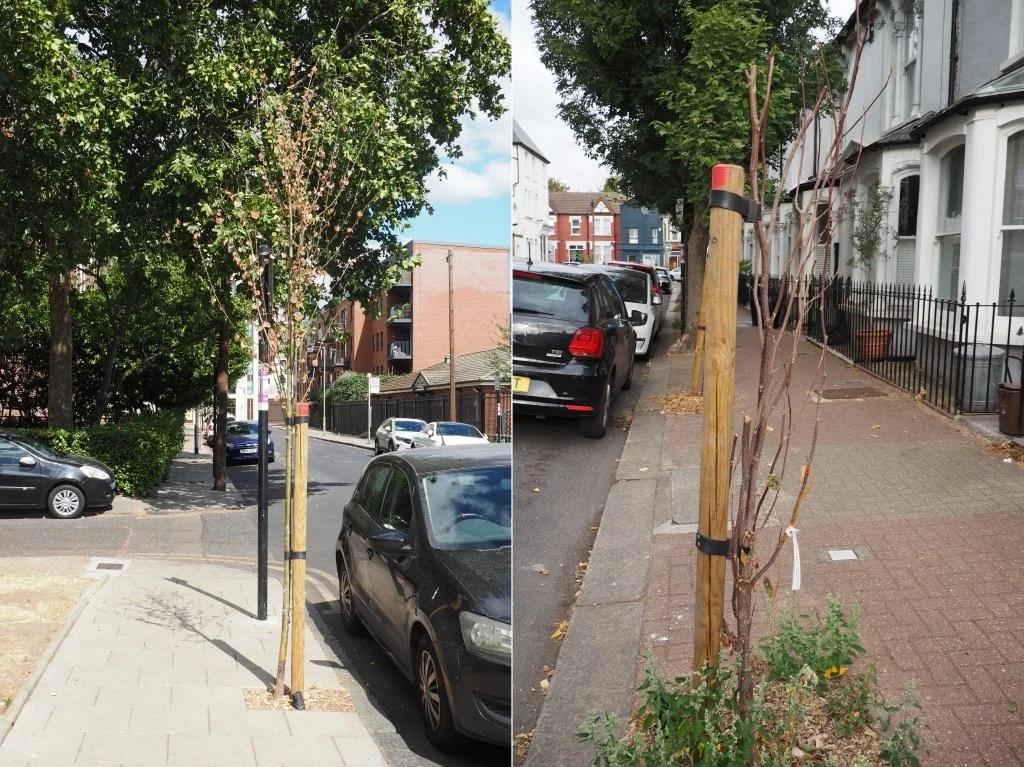
Two dead 2025-6 trees in Shaftesbury and Queenstown Ward, on Ascalon Street (L) and Amies Street (R).
Wandsworth proudly announced that it had put in a thousand new trees across the borough during the 2025-6 planting season, but alas it has not done too good a job so far on maintaining them. A new contractor, Glendale, took on the watering contract on 1 April and as the drought took hold my fellow Wandsworth Tree Wardens and I soon realised that it wasn't watering the trees as often as they needed. Fortnightly would have been usual in a normal year, but in the hot dry conditions we were experiencing the young trees should have been visited by Glendale's watering trucks weekly or still more often. From the reports that were coming in from right across the borough, this just wasn’t happening. As a result many trees were dead or struggling, especially it seemed those planted in commons and in other open spaces, which were more complicated for the trucks to access. Greenspace groups like the Friends of Wandsworth Common had therefore had to set up volunteer watering teams, trundling heavy containers of water by hand across the grass and to the trees.
Wanting some local facts and figures, at the end of July I revisited the thirty-three 2025-6 trees in the Shaftesbury and Queenstown ward that I had surveyed back in early June for the 2026 Wandsworth Young Street Tree Survey. I was shocked to discover that no fewer than five had died; another five were clearly struggling. Checking their individual records on the Wandsworth Tree Portal revealed that each of them had only been watered once a fortnight, at best. Armed with this information and on behalf of the Society I wrote to Councillor Ethan Brooks, the Wandsworth Cabinet Member for Environment. When his reply came through on 21 August it was full and informative, evidently written with input from the Council's Tree Team. He told me that around 80 trees have been confirmed as dead so far, from the 1,000 trees that were planted during the 2025-2026 planting season. Overall, this represents a relatively small proportion of the planting programme, but we are keen to prevent this number rising any further.... The watering contract is structured so the responsibility for keeping newly planted trees sits with the contractor. Officers have met with the watering contractor over the past fortnight, and I understand there have been some operational issues around staffing. These issues do not in any way excuse the contractor from their contractual obligations, but it is useful to understand the reasoning behind the shortcomings. Changes have been made by the contractor, and officers are meeting with the contract again to ensure the level of watering returns to where it should be. In the autumn, when watering for the year is no longer required, officers will finalise the checks to the records and all financial penalties will be applied to the contractor.... Some level of failure is expected within large-scale planting programmes like ours, but five trees in one ward is upsetting to see... I am grateful that these concerns have been brought to our attention and welcome the continued support of the Battersea Society and Wandsworth Tree Wardens in helping us monitor the health of the borough's young trees.
Going Forward
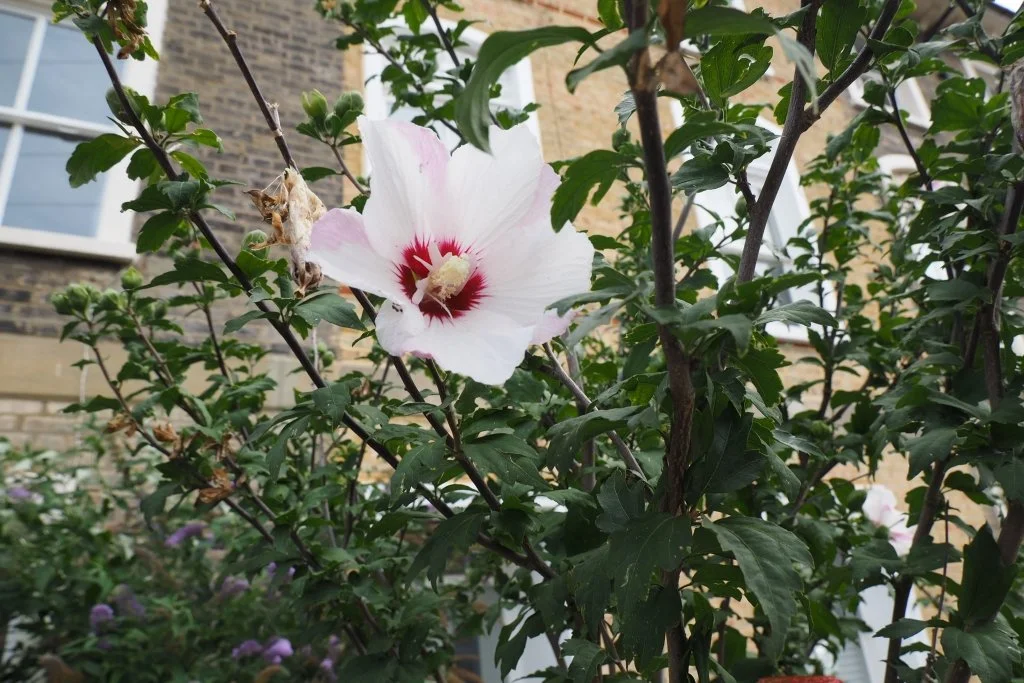
This 2025-6 Hibiscus Syriacus is growing well in Shaftesbury and Queenstown ward’s St Philip Street
So Glendale will at least be responsible for the cost of replacing those trees already lost through its negligence, and should be watering the remaining ones at more frequent intervals for the rest of the growing season, so that they can survive and even flourish. It's still regrettable that 8% of last season's plantings have been lost to date to human error: trees are much too environmentally important, too beautiful and for that matter too expensive to be treated as disposable items. On the other hand, I have been cheered to see some of the survivors growing and thriving, despite their rough and thirsty start—like this flowering hibiscus in St Philip Street, one of the new species being trialled by the Tree Team for its climate change resilience. It was also good to see the Council last month urging neighbours to help out new trees with extra water, via social media and Brightside; it is also I hear planning to set up its own Trees for Streets Watering Champions scheme ahead of the next planting season. Community involvement is to be encouraged going forward, not as a substitute for a proper official watering regime but as a way to encourage us all to take an interest in, and help look out for, the trees that are our neighbours. That's something that's long been recognised by WTW, who already attach their own watering labels to many new trees.
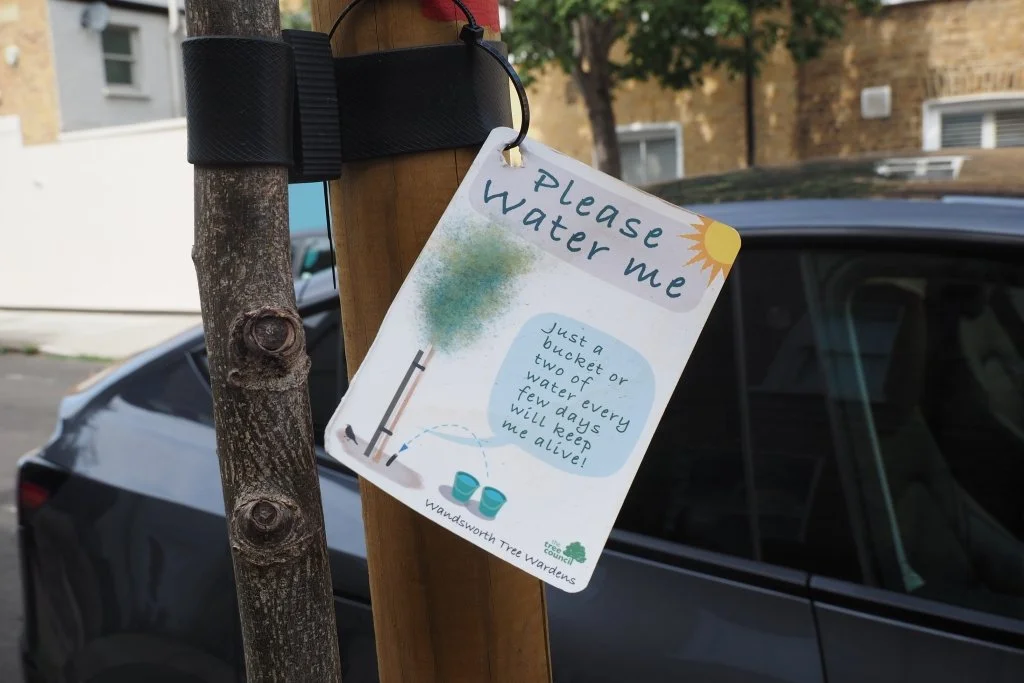
A Wandsworth Tree Wardens watering label on a 2025-6 Carya illinoinensis in Shellwood Road, Shaftesbury and Queenstown ward.