
Our 2025 Wildflower Survey
By Clare Graham, Chair, Open Spaces Committee
The plant species count was up for the third year running as we recorded wildflowers in Christchurch Gardens and Falcon Park again this June with the help of Enable Biodiversity.
Our third annual survey
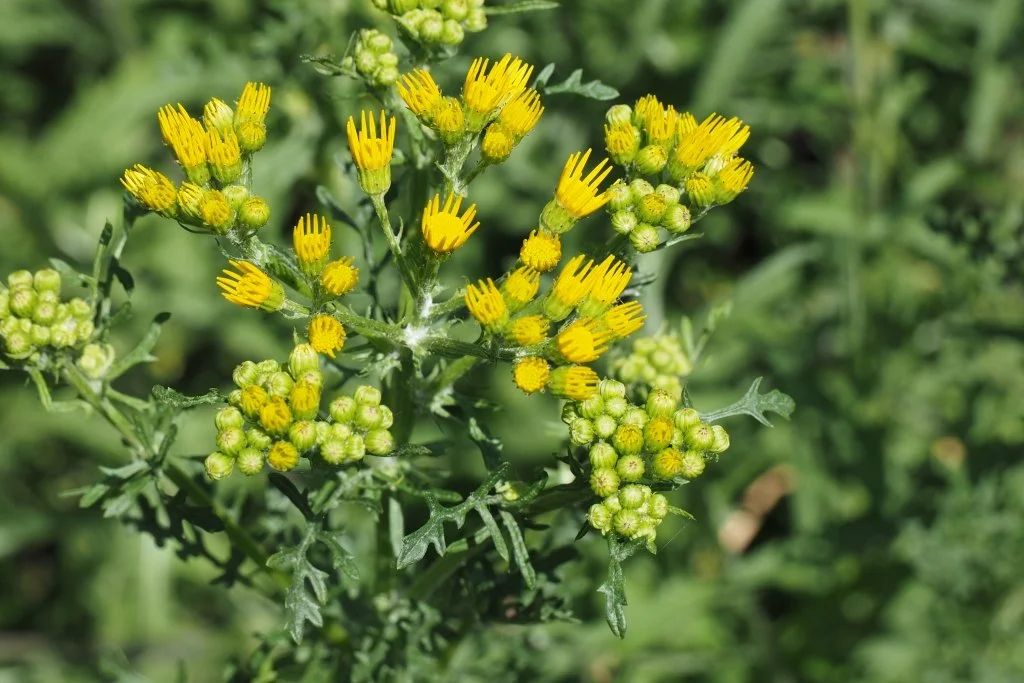
Common Ragwort in Christchurch Gardens. All photos in this article © the author.
It was great to meet up again on 12 June with Ling and Brieannah from Enable Biodiversity for a third annual Battersea Society wildflower survey. My fellow committee member Barbara came along to help, together with Society members Carole, Laila and Sumi. Once more we were back in Christchurch Gardens and Falcon Park, spotting and identifying wildflowers in a couple of small areas deliberately managed to encourage these to flourish; this is always a very pleasant way to spend a couple of hours on a summer afternoon, especially when the results are as good as they were this year.
Christchurch Gardens
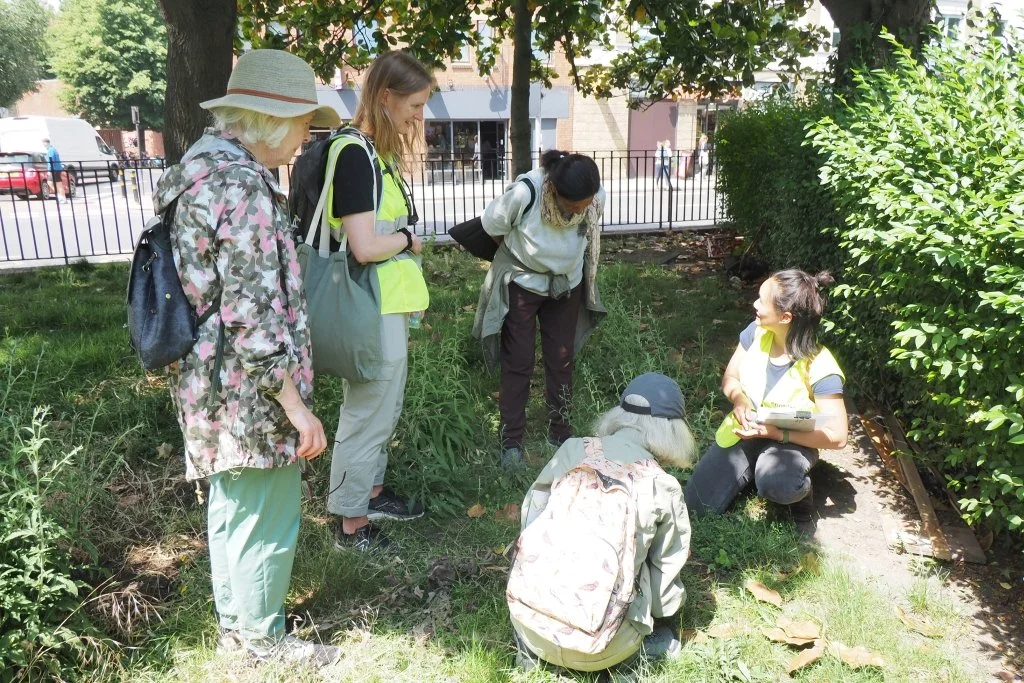
Getting down to work in Christchurch Gardens.
We started off in Christchurch Gardens, where last year we found 38 species in the unmown strip of grass beside the railings on Battersea Park Road. This year that rose to 43 species, though in both years the picture has been confused somewhat by various plants thought to have been introduced by an unofficial local gardening group. Here's Ling's list for this year, with each plant identifed by family, species and common name, followed by any notes.
1, Apiaceae, Conium maculatum, Hemlock
2, Araliaceae, Hedera sp., Ivy
3, Asteraceae, Achillea millefolium, Yarrow
4, Asteraceae, Bellis perennis, Common daisy
5, Asteraceae, Centaurea nigra, Common knapweed
6, Asteraceae, Cirsium arvense, Creeping thistle
7, Asteraceae, Cirsium vulgare, Common thistle/spear thistle/bull thistle
8, Asteraceae, Hypochaeris radicata, Cat's ear
9, Asteraceae, Lapsana communis, Nipplewort
10, Asteraceae, Leucanthemum vulgare, Oxeye daisy
11, Asteraceae, Senecio jacobaea, Common Ragwort
12, Asteraceae, Sonchus oleraceus, Smooth sow-thistle
13, Asteraceae, Taraxacum sp., Dandelion
14, Boraginaceae, Pentaglottis sempervirens, Green alkanet
15, Brassicaceae, Sisymbrium officinale, Hedge mustard
16, Crassulaceae, Sedum sp., Sedum, stonecrop
17, Fabaceae, Lotus corniculatus, Common bird's foot trefoil
18, Geraniaceae, Geranium molle, Dove's-foot crane's-bill
19, Geraniaceae, Geranium robertianum, Herb Robert
20, Lamiaceae, Ballota nigra, Black horehound
21, Monocotyledonous sp., Suspected grape hyacinth. Spent flowerheads remaining on stems
22, Oxalidaceae, Oxalis sp., Wood-sorrel
23, Papaveraceae, Papaver somniferum, Opium poppy, Single specimen, spent flower, seedhead remains
24, Plantaginaceae, Plantago lanceolata, Ribwort plantain
25, Plantaginaceae, Veronica chamaedrys, Germander speedwell, bird's-eye speedwell,
26, Plantaginaceae, Veronica persica, Common field-speedwell
27, Poaceae, Bromus sterilis, Barren brome
28, Poaceae, Dactylis glomerata, Cock's foot
29, Poaceae, Holcus lanatus, Yorkshire fog
30, Poaceae, Lolium perenne, Perennial rye-grass
31, Poaceae, Poaceae sp., Grass species, Unidentified grass species
32, Polygonaceae, Rumex sp., Dock/sorrel
33, Ranunculaceae, Ranunculus acris, Meadow buttercup
34, Ranunculaceae, Ranunculus repens, Creeping buttercup
35, Rosaceae, Geum urbanum, Wood avens
36, Rosaceae, Potentilla reptans, Creeping cinquefoil
37, Rosaceae, Rosaceae sp., Rose, Likely cultivar
38, Urticaceae, Urtica dioica, Common nettle
39, Violaceae, Viola odorata, Sweet violet, common violet
40, Dicot. Sp. 1, Suspected Brassicaceae sp.
41, Dicot. Sp. 2, Suspected iris
42, Dicot. Sp. 3
43, Fern, Likely a persisting planted cultivar.
Falcon Park
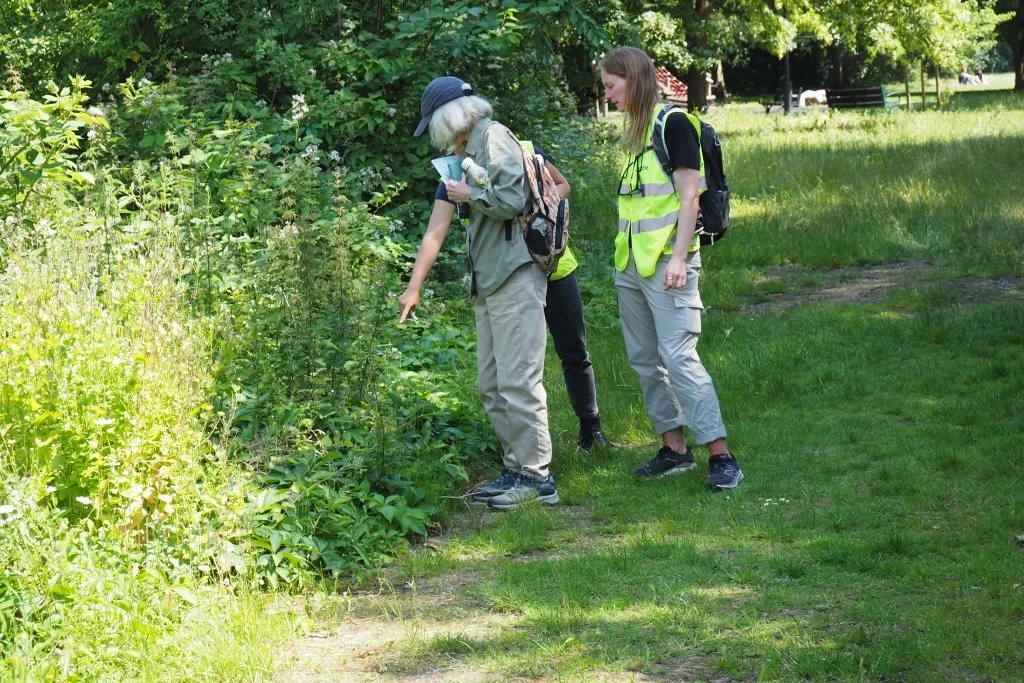
Plant-spotting in Falcon Park.
After that we moved on to survey the north end of Falcon Park. This triangle of land between the railway embankments was the site of our first survey back in 2023, when we found 29 species. Last year there were 40, and this year the count was up to 50. What an encouraging result: to the casual eye this is just a scrap of waste land, plagued by litter from the adjoining foot and cycle path, and all too often squashed by parked-up Network Rail maintenance vehicles. Nevertheless, ever since the decision was taken back in 2019 to open it up and leave it to nature, it has thrived. New species continue to arrive and flourish of their own accord (it has never been deliberately sown), encouraged by the thin soil and sheltered location. Probably some have blown in from adjacent railway land, an important biodiversity resource. Here's Ling's list for this year; our thanks go once more to her and Brieannah, for another very enjoyable and interesting afternoon.
1, Apiaceae, Anthriscus sylvestris, Cow parsley
2, Asteraceae, Achillea millefolium, Yarrow
3, Asteracea, Arctium minus, Lesser Burdock
4, Asteraceae, Bellis perennis, Common daisy
5, Asteraceae, Centaurea nigra, Common knapweed
6, Asteraceae, Cirsium vulgare, Common thistle/spear thistle/bull thistle
7, Asteraceae, Galinsoga quadriradiata, Shaggy soldier
8, Asteraceae, Hypochaeris radicata, Cat's ear
9, Asteraceae, Lapsana communis, Nipplewort
10, Asteraceae, Leucanthemum vulgare, Oxeye daisy
11, Asteraceae, Sonchus oleraceus, Smooth sow-thistle
12, Asteraceae, Taraxacum sp., Dandelion
13, Boraginaceae, Pentaglottis sempervirens, Green alkanet
14, Brassicaceae, Alliaria petiolata, Garlic mustard
15, Brassicaceae, Brassicaceae sp.
16, Brassicaceae, Capsella bursa-pastoris, Shepherd's purse
17, Brassicaceae, Sisymbrium officinale, Hedge mustard
18, Caryophyllaceae, Cerastium sp., Mouse-ear
19, Caryophyllaceae, Silene dioica, Red campion
20, Caryophyllaceae, Silene latifolia, White campion
21, Caryophyllaceae, Stellaria media, Common chickweed
22, Convolvulaceae, Calystegia silvatica, Large bindweed
23, Fabaceae, Lotus corniculatus, Common bird's foot trefoil
24, Fabaceae, Trifolium dubium, Lesser Trefoil, Lesser hop trefoil
25, Fabaceae, Trifolium repens, White clover
26, Geraniaceae, Geranium molle, Dove's-foot crane's-bill
27, Geraniaceae, Geranium robertianum, Herb Robert
28, Lamiaceae, Ballota nigra, Black horehound
29, Malvaceae, Malva sylvestris, Common mallow
30, Plantaginaceae, Plantago lanceolata, Ribwort plantain
31, Plantaginaceae, Plantago major, Greater plantain
32, Plantaginaceae, Veronica sp., Speedwell
33, Poaceae, Arrhenatherum elatius, False oat-grass
34, Poaceae, Bromus sterilis, Barren brome
35, Poaceae, Dactylis glomerata, Cock's foot
36, Poaceae, Hordeum murinum, Wall barley
37, Poaceae, Lolium perenne, Perennial rye-grass
38, Poaceae, Poa sp., Meadow-grass species
39, Polygonaceae, Rumex sp., Dock/sorrel, possibly R. obtusifolius
40, Ranunculaceae, Ranunculus acris, Meadow buttercup
41, Ranunculaceae, Ranunculus repens, Creeping buttercup
42, Rosaceae, Potentilla reptans, Creeping cinquefoil
43, Rosaceae, Rubus 'fruticosus', Bramble
44, Rubiaceae, Galium album syn. Galium mollugo, Hedge bedstraw
45, Rubiaceae, Galium aparine, Cleaver, goosegrass
46, Rubiaceae, Galium verum, Lady's bedstraw
47, Urticaceae, Urtica dioica, Common nettle
48, Urticaceae, Urtica sp., Nettle, Suspected U. urens, small nettle
49, Vitaceae, Parthenocissus quinquefolia, Virginia Creeper, woodbine
50, Dicot. sp. 1, young plant, basal leaves only. Perhaps Verbascum sp., mullein? (as last year).
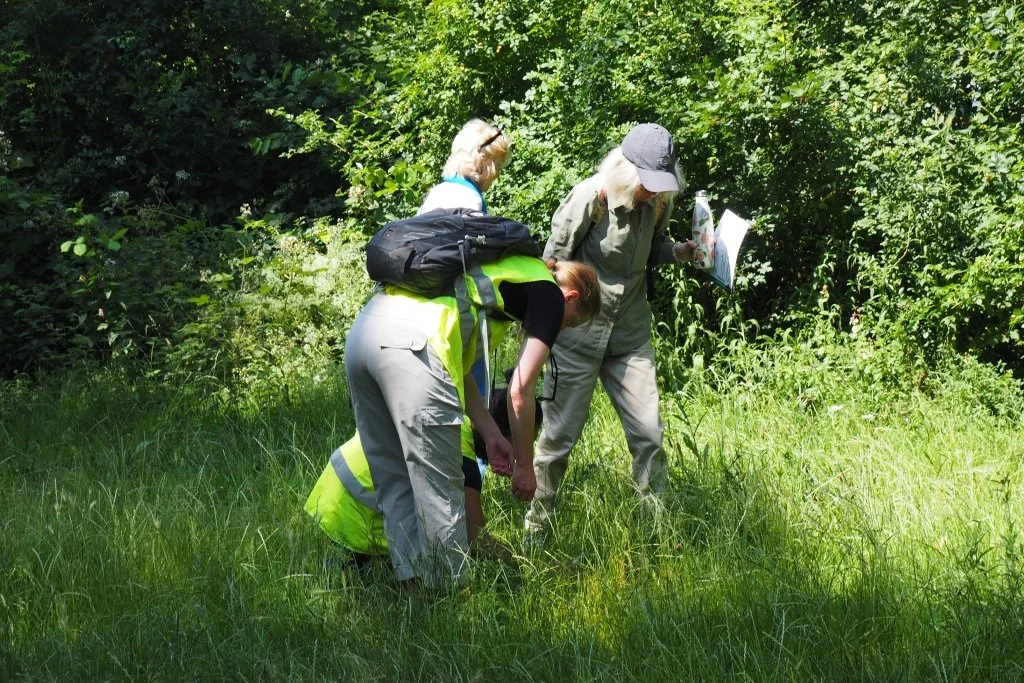
In Falcon Park, again.