
Open Spaces Walk no. 1
by Clare Graham, Chair, Open Spaces Committee
Click + or - on the route map above to zoom in or out, or on the square symbol at the top and on the right to show it full-screen.
Walk no.1: St John’s Hill to Battersea Park
Route description: Walk through a winding string of smaller green spaces created between the 1880s and the 1980s, all distinct in character but never far apart. End with coffee in Battersea Park.
Start point: St John’s Therapy Centre, 162 St John’s Hill, SW11 1SW.
Finish point: Putt in the Park café, Battersea Park, SW11 4NJ.
Route length: 4.75 km/ 3 miles.
Facilities: Public toilets and refreshments available in Battersea Park, at the end of the walk.
Accessibility: Mostly level, after the downhill section at the beginning. Much of the route is pedestrianised, but there are also several busy roads to cross.
Public transport links: Buses 337, 37, 39, 87, 156, 170 and 337 all pass St John's Therapy Centre; get off at the Marcilly Road stop. At the end of the walk, catch a 44, 49, 319, 344 or 345 from The Latchmere; Battersea Park railway station is also nearby.
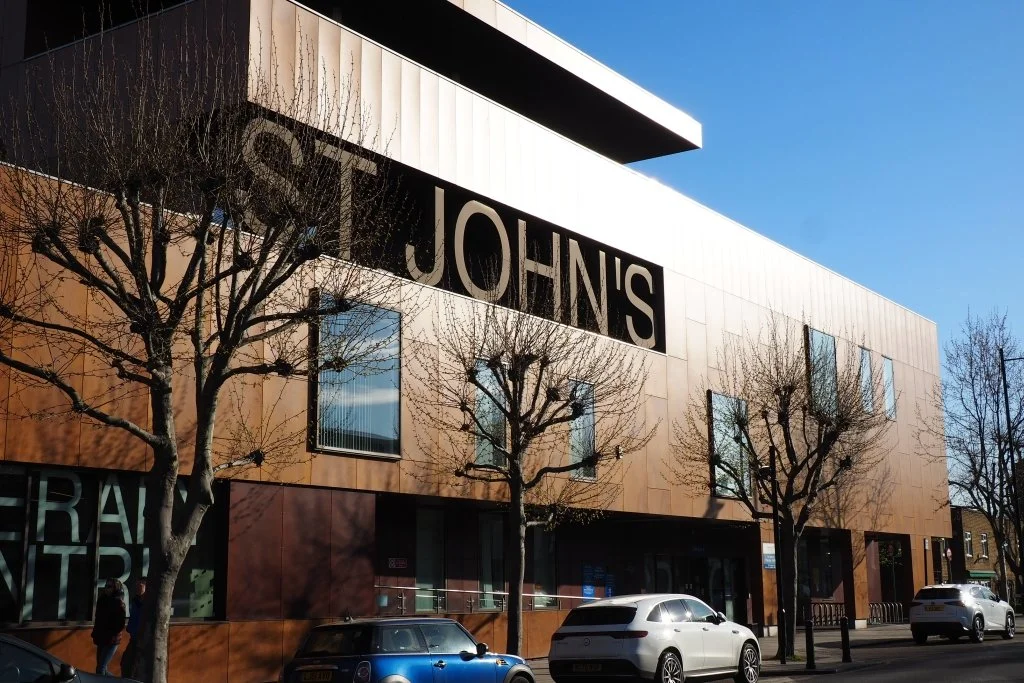
Start Point: St John’s Therapy Centre
Start your walk in front of this modern building (2005-7, by Buschow Henley) on the site of the former St John’s Hospital. Heading East towards Clapham Junction walk down Haydons Close, the first road on your left. Amidst 1970s-80s housing some old hospital blocks survive, repurposed as flats. Take next a footpath on the right leading into Rochelle Close. Turn left onto that and head downhill, then at the bottom left again along Nantes Close. Then head right under the railway viaduct.
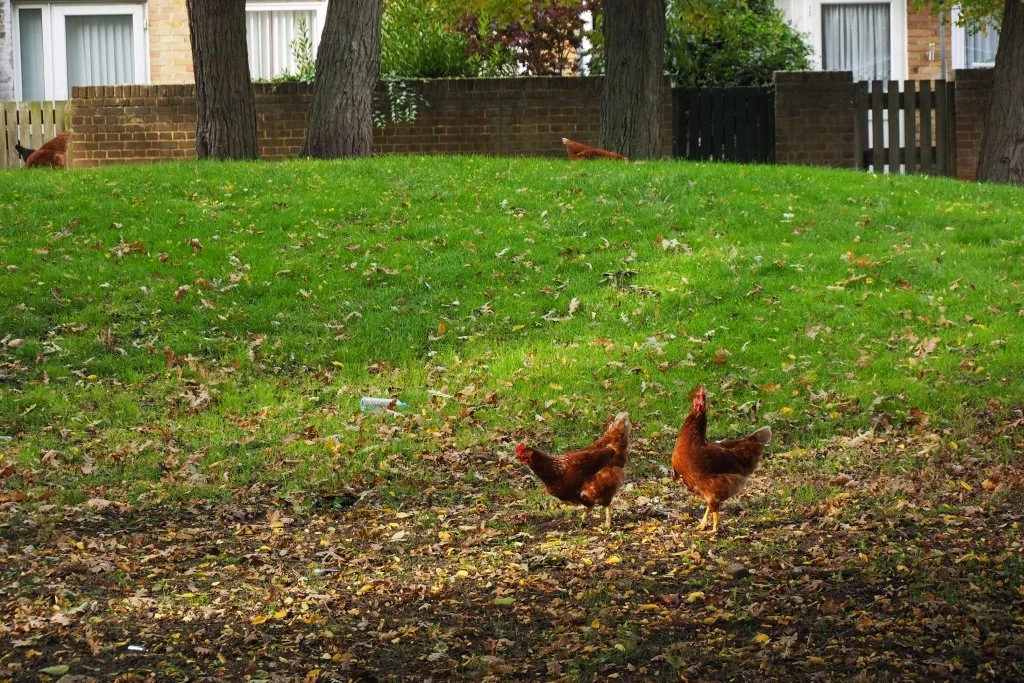
Petergate Green
On the far side is the first open space on this walk. It's just grass and trees; the many hummocks are characteristic of new open spaces created locally within slum clearance programmes, from the 1950s onwards. Underneath is rubble from the previous buildings — a quick, cheap and easy fix, also good for deterring ball games. With luck you might encounter the rescue chickens kept by one neighbouring resident, also out for a stroll.
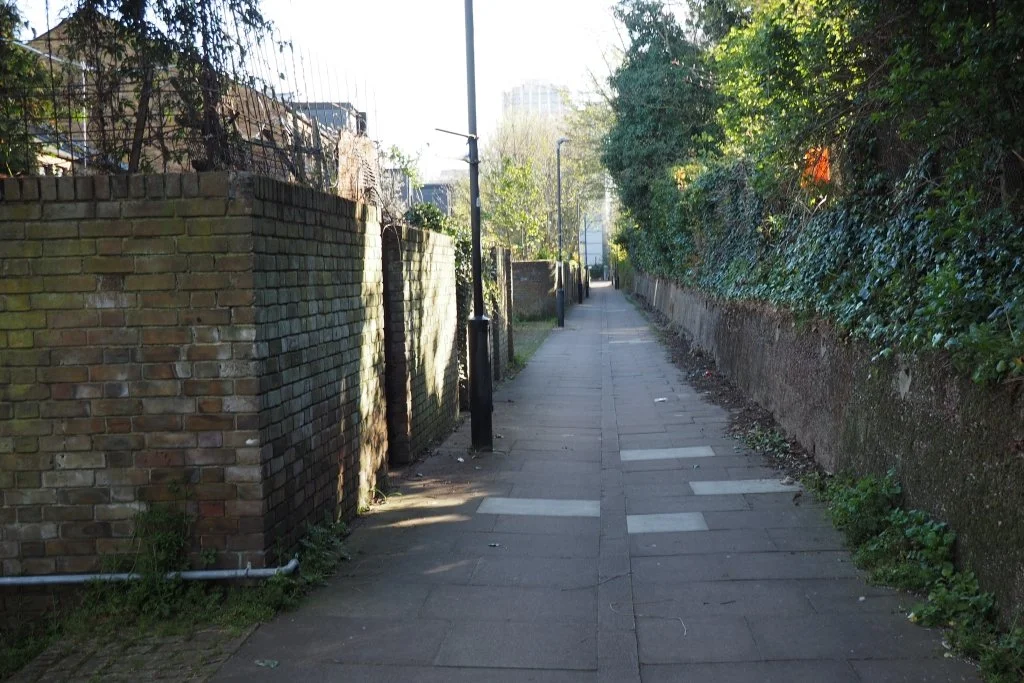
Tours Passage
Turn sharp right on the Green, following a quiet cycle and pedestrian route between the railway embankment and the 1970s Maysoule Estate. This is Tours Passage, picturesque with hanging creepers. At the end is busy Plough Road; turn left into this, crossing over to the other side when you reach the designated pedestrian crossing.
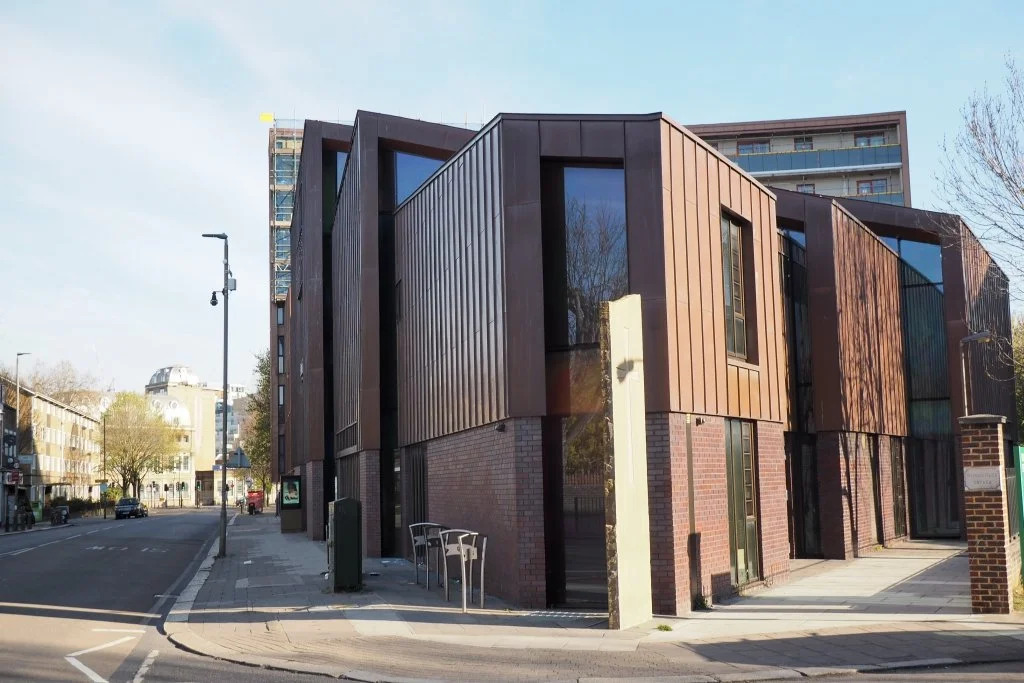
St Peter’s Church and Monolith
Carry on as far as St Peter's church (2019, Portal Architecture), which has a stone monolith carved by Richard Kindersley at its first corner. Turn right down the foot passage beside that, following this into the Winstanley Estate (1956-72). Together with the neighbouring York Road estate this is currently undergoing regeneration.
York Gardens
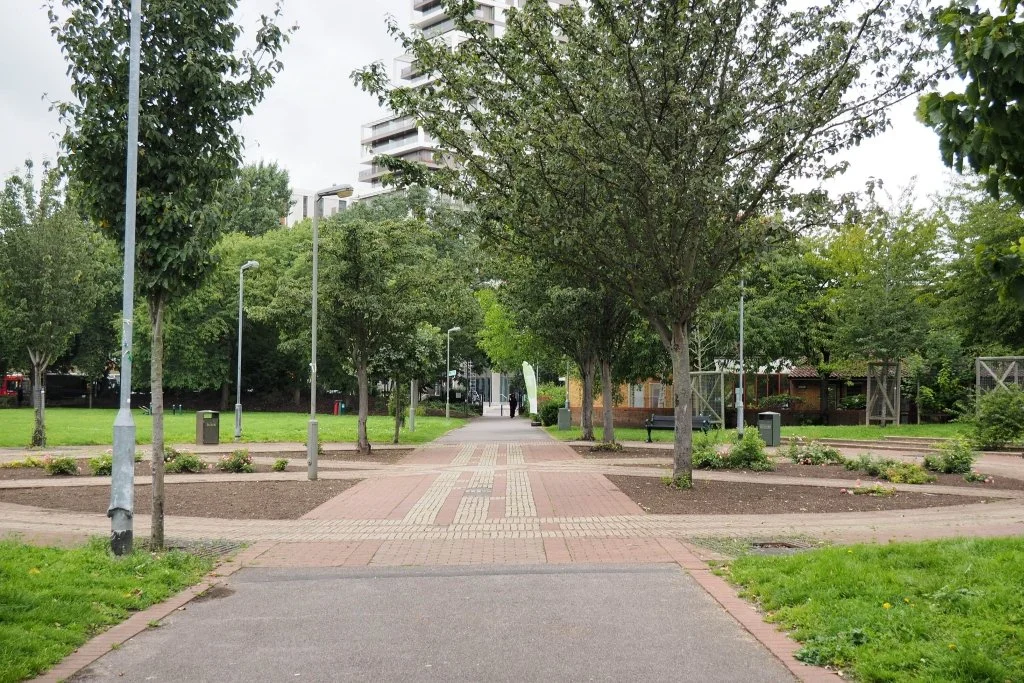
Soon on the left appears York Gardens (1972; Howes Jackman & Partners for Wandsworth Council). Currently partially closed and looking rather sorry for itself, this park remains a much loved and valued community space, now awaiting resiting and improvement. Walk along its railings to the corner of Newcomen Road, then enter and follow the wide path through the central wheel of flower beds and out onto York Road.
The Sundial and Harroway Gardens
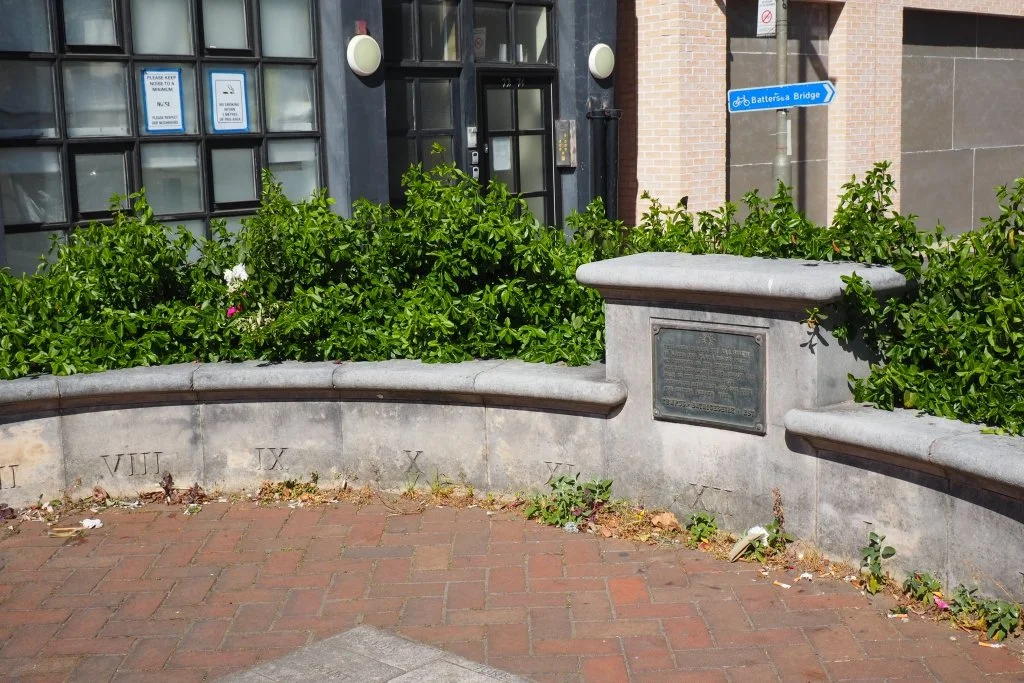
Cross busy York Road with care, turn right and walk on to find a low mound of greenery. Inside is an intriguing and rather mysterious 'human sundial', presumably provided during local post-WW2 redevelopment. Turn left beside it down Yelverton Road; on your left is Harroway Gardens. This small park and playground was created in the late 1970s on the site of war-damaged Victorian terraces; it has particularly extravagant hummocks. Recent improvements (2025) include new landscaping, and a new through route. Follow that and turn left as you leave the Gardens, along Gwynne Road. Then turn right along Lombard Road.
Fred Wells Gardens
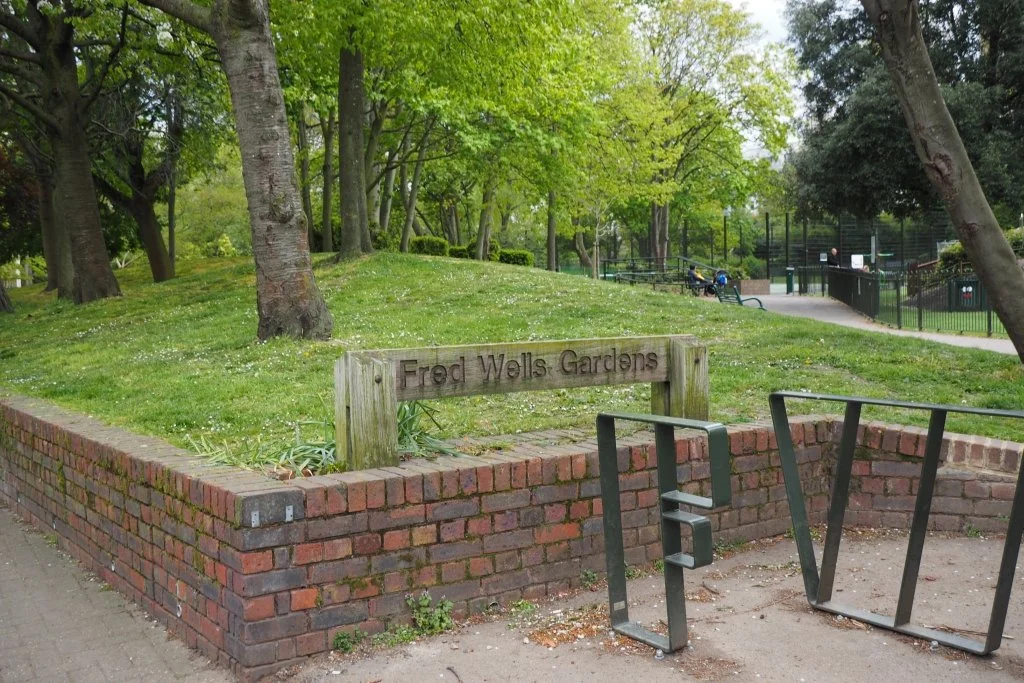
Beyond another railway viaduct and on the right lies attractively-landscaped Fred Wells Gardens, named for a popular local Councillor who died in 1982. This was the last post-war open space deficiency area park created by Wandsworth Council; here formerly had been workshops and a greyhound racing track, then some temporary prefab housing. Walk past its playgrounds and tennis court and out onto Orville Road. Once past the Katherine Low Settlement, turn right into Battersea High Street. To your left is a new paved open space beside Sphere Walk, recently created by Wandsworth Council. Bleak at present, this could be transformed into a real public asset with some seating, and some greening—we'd like to see pedestrians and cyclists encouraged to use the passage beyond too, which provides a quiet link through to Home Road and beyond that to Battersea Park Road.
Christchurch Gardens
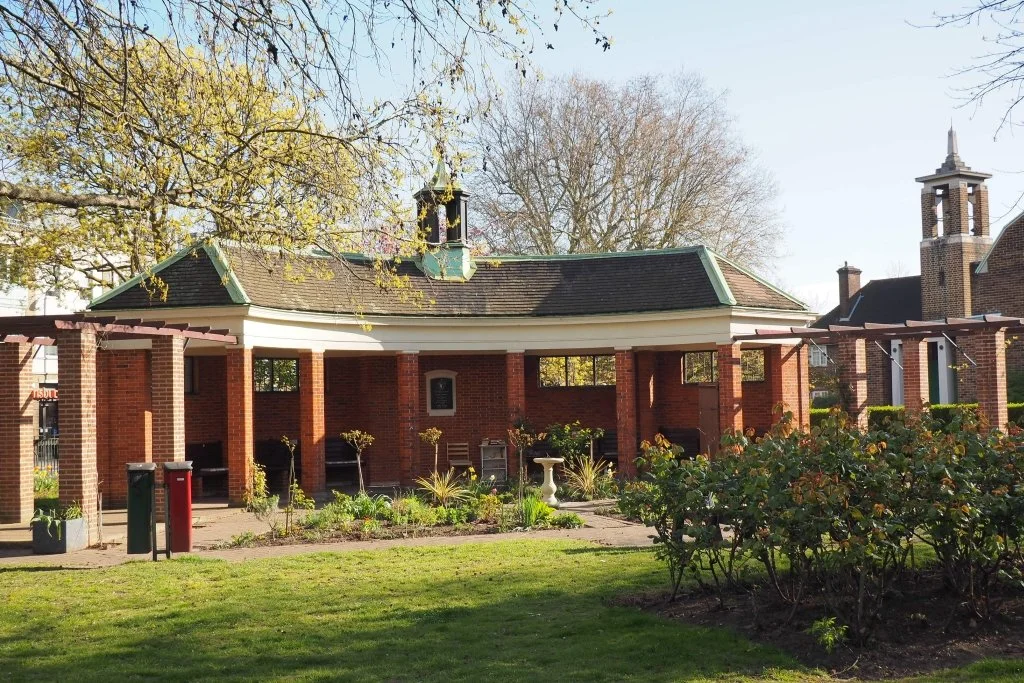
Walk up Battersea High Street to Battersea Park Road. Cross carefully over towards The Falconbrook pub, then head left along Cabul Road to enter Christchurch Gardens. This site was originally intended to be a graveyard for neighbouring Christ Church (1847-9, rebuilt 1957-9) but was never used for burials. Instead it was taken on and transformed by the Metropolitan Public Gardens Association, opening in 1885. After World War Two Battersea Borough Council redesigned it as a formal setting for a its striking and unusual memorial to Battersea's civilian war dead (1951, by the Borough Surveyor; listed Grade II). In front of that is a large bed of 'Peace' roses. This beautiful, vigorous new hybrid tea variety had been released in 1945, and handed out to those attending the inaugural meeting of the United Nations in the same year. It was to become hugely popular with post-WW2 gardeners.
Falcon and Shillington Parks
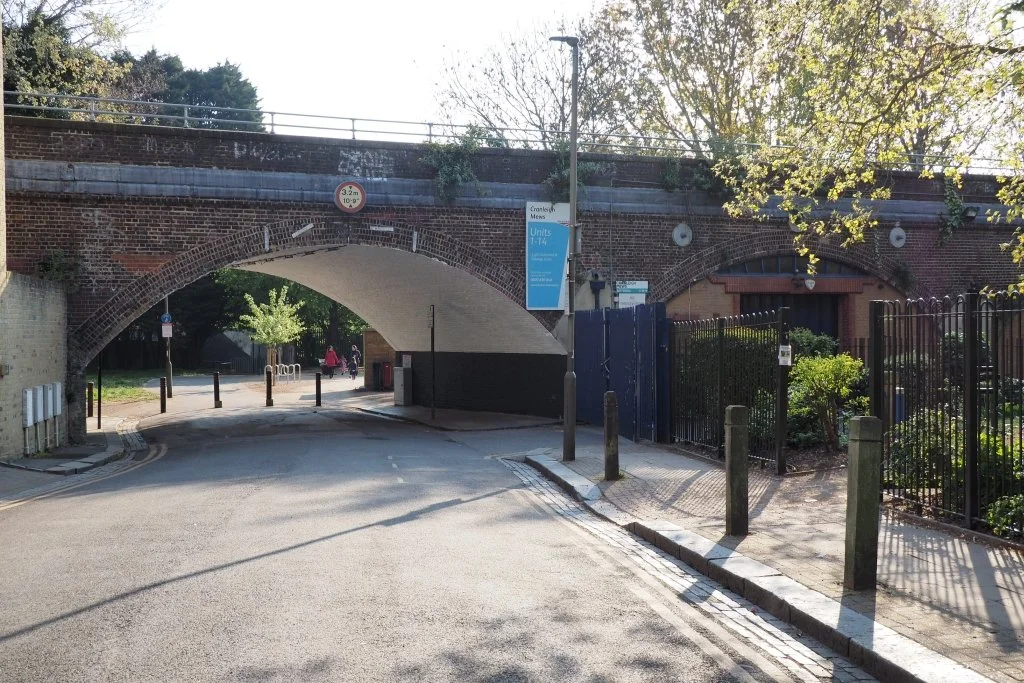
Further along Cabul Road are two more slum clearance parks, side by side. First comes Shillington Park, opened by Wandsworth Council around 1977, after being used for prefab houses and as a Travellers' site. Turn right to walk through it, and then left under a railway arch into neighbouring Falcon Park (1966, London County Council; also known as Banana Park for its curving shape). Falcon Park was once Latchmere Grove, a street of Victorian terraced housing still occupied in the 1950s.
Some 1953 Coronation Graffiti
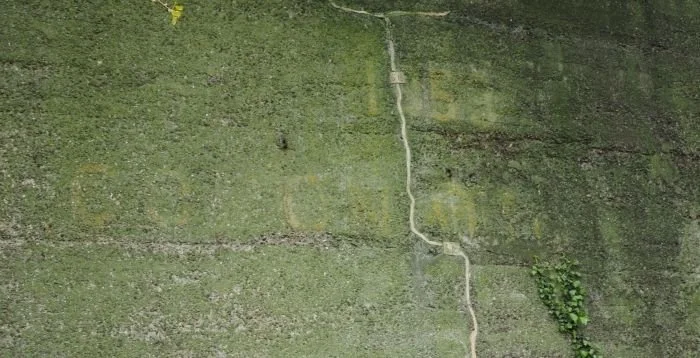
In 1953 Latchmere Grove's residents marked Queen Elizabeth II's Coronation with some celebratory graffiti; the yellow paint they used is now very faded, but to find it turn right, up the path beside the artificial football pitch. It's on the railway embankment wall at the far end, directly opposite you. Afterwards retrace your steps and then follow the path across Falcon Park, back towards Cabul Road. This now becomes Latchmere Passage, a cobbled path leading under two more railway bridges and out onto Latchmere Road. Take the Pelican crossing across that, turn left and then right into Burns Road. This area was formerly Battersea’s Latchmere Common, which was enclosed and turned into allotments in the 1830s.
Latchmere Recreation Ground
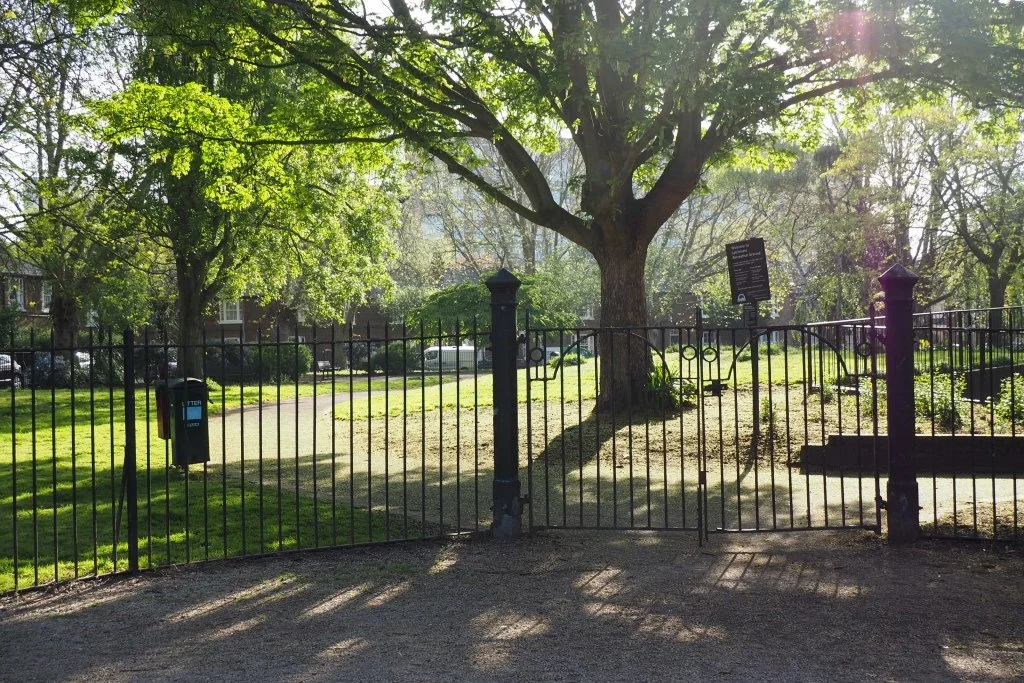
Ahead of you lies the Borough of Battersea's pioneering Latchmere Estate, built on the allotment site in 1902-3 and now a conservation area.Look out for a plaque on a house wall to your right, summarising its history. Then turn left into Latchmere Recreation Ground, created in 1906 as the centrepiece of the Estate. Its iron gates and some of its railings are original still, though now much in need of restoration. At its centre originally too sat Brown Dog, a controversial anti-vivisection memorial; by 1907 today's peaceful neighbourhood park had become the scene of riots, with locals and radicals battling outraged medical students intent on pulling it down. The memorial survived until 1910, when a new council quietly removed it overnight. Only in 1985 would a replacement be provided, this time in Battersea Park.
End Point: Battersea Park
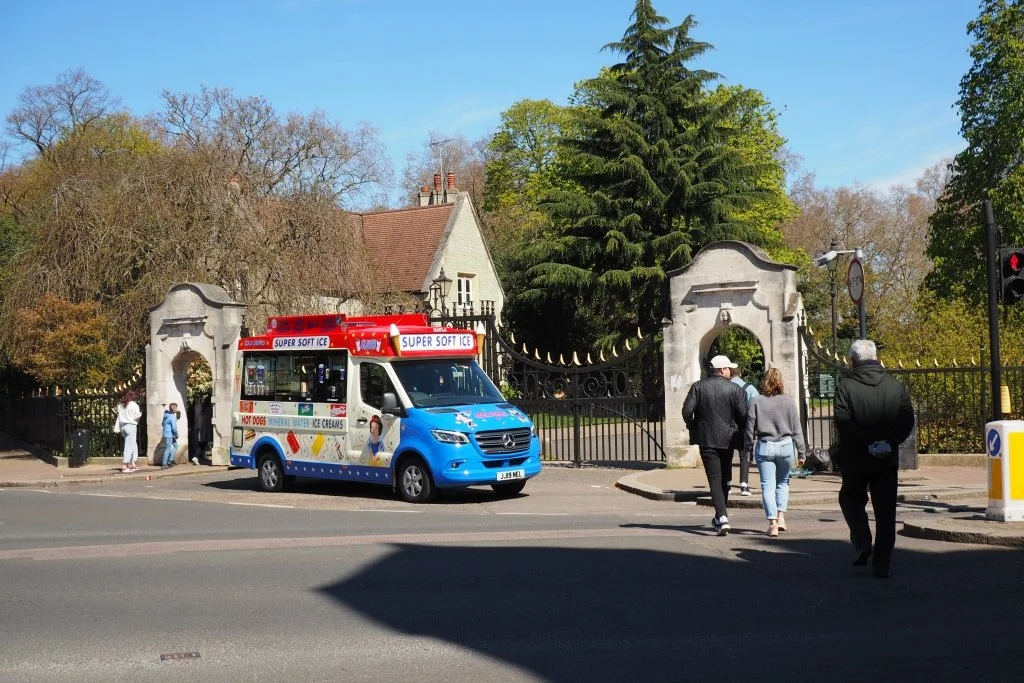
Once you have finished exploring Latchmere Rec, walk down St James's Grove to Battersea Park Road. Turn left, then cross over at the traffic lights to turn right down Albert Bridge Road. When you reach Prince of Wales Drive, cross over and enter Battersea Park via Sun Gate. Walk straight ahead past the big horse chestnut tree in a raised circular bed, and along the path beyond. To your right is Putt in the Park, a mini-golf course whose friendly café is open to all park visitors and serves excellent coffee; if you're hungry it has its own pizza oven, too.