
How do you use Battersea Park?
By Clare Graham, Chair, Open Spaces Committee
Take ten minutes if you can to help inform the park’s current Victorian Cascades restoration project, by filling in a brief survey from Enable Parks.
The Victorian Cascades restoration project
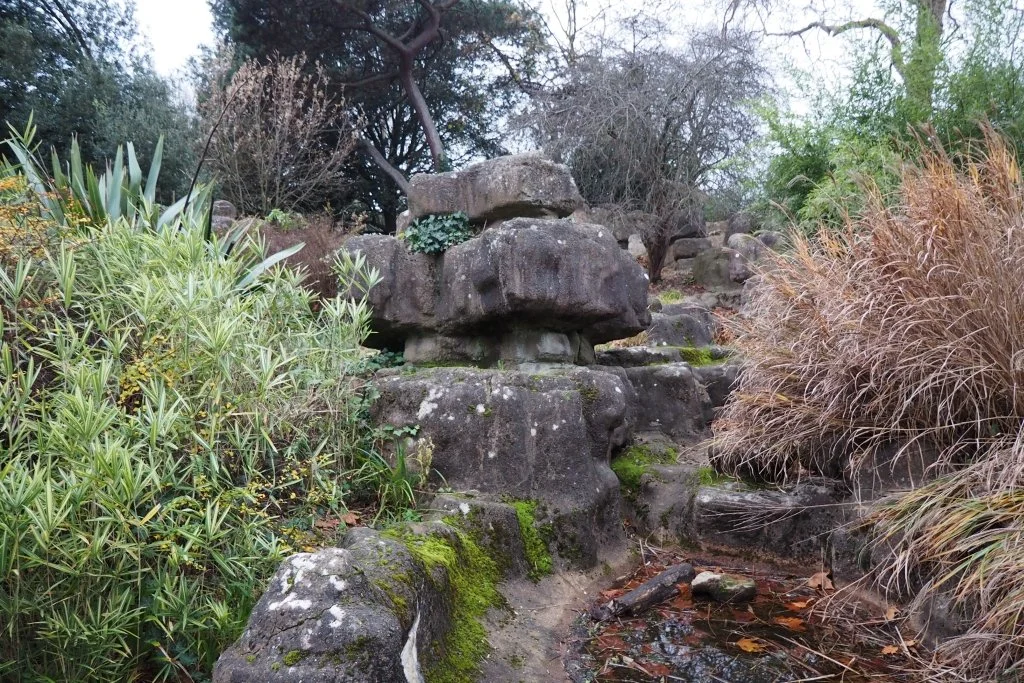
In need of restoration: the Victorian Cascades beside Battersea Park’s boating lake. Photo © the author.
I gave this major project a brief mention at the bottom of a blog previously, back in December 2024 when I’d just agreed to join its steering committee. If you’re not familiar with the Park’s Pulhamite Rockery and Cascades, here they are above, in their current sorry state (with another photograph below, showing their former glory). Take the scenic Victorian path around the perimeter of the lake and they are on its west side, directly opposite the terrace of the Pear Tree Café. Dry and leaf-filled now, they were designed as a central and spectacular feature of the Victorian park, cascading water into its ten-acre lake and powered by an engine in what is now the Pump House Gallery. Look closely at the ‘rocks’ which make up the Cascades and are scattered around the surrounding area, and you will see that they are actually artificial, created in 1865-6 by celebrated garden landscaper James Pulham II, using builders’ waste and his own brand of proprietary cement. This was his first work in a public park in London and it remains an unusual survival; it’s one of the reasons for the park’s Grade II* listing.
Unfortunately, the whole ensemble is now sadly decayed. The water feature no longer works: it was switched off long ago, between the First and Second World Wars. And extensive erosion and trespass have left the rockwork in disrepair, a situation worsened by some misguided restoration attempts in the 1980s. So it was good to hear in 2024 that Wandsworth Council had been awarded development funding of £654,757 by The National Lottery Heritage Fund towards their restoration. This development funding was to allow Enable Parks to work up on the Council’s behalf a second-stage application to be submitted in 2026, for £2,714, 547 to cover the actual restoration. Much of this is for the actual physical works: repairing damaged rockwork, installing modern water and power systems, and appropriate new plantings. But the NLHF will need evidence that the project will deliver other benefits too, before it can hand out the funding. The second-stage application must demonstrate that the project will be sustainable (and the Cascades themselves sustainably powered!), that it will secure and improve the park’s natural environment as well as its built heritage, and that it will provide excellent, educational and inclusive community programming and volunteering opportunities.
Engineers, naturalists and other appropriately qualified experts have I know been pulling together the necessary information for the physical works, so now it’s down to the rest of us to help out on the community side. It would be great therefore if you could fill in a brief survey, which will run until summer 2026 and has been produced by Enable Parks’ Engagement and Inclusion Officer. She tells us: ‘I am creating an Activity Plan and Interpretation Plan to guide future activities, learning opportunities, and volunteering in the park. I am gathering input from local organisations, residents and park users to understand how people use Battersea Park, what activities they’d enjoy, and how the park can be more welcoming, safe and engaging for everyone. I’d be really grateful for your input and support on the project by sharing and filling out this survey: Battersea Park Survey. It should take less than 10 minutes to complete and can be filled out by everyone!’
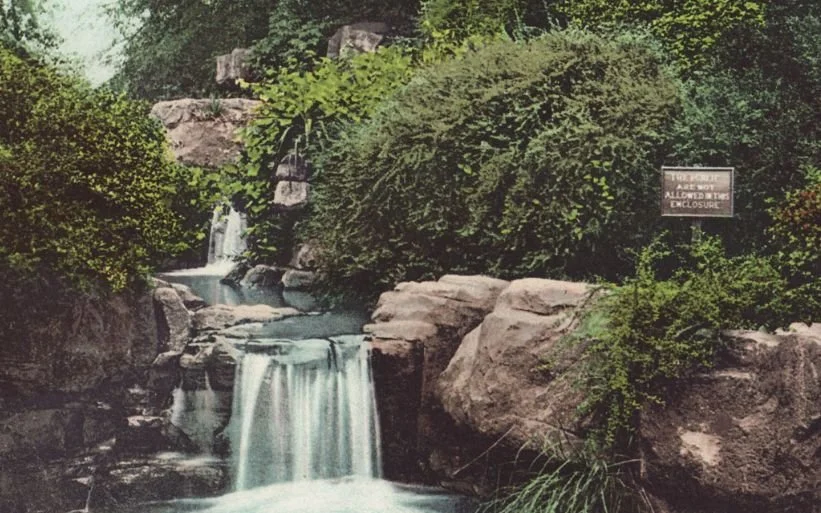
Old colour photograph, with the Cascades still in working order. Supplied by Enable Parks.