
Good Parks for London 2024
By Clare Graham, Chair, Open Spaces Committee
Both Wandsworth and Lambeth Councils have cause to celebrate within this recently-published report - and there's progress to report too on a long-awaited project to restore Battersea Park's Victorian Cascades.
Wandsworth and Lambeth Councils
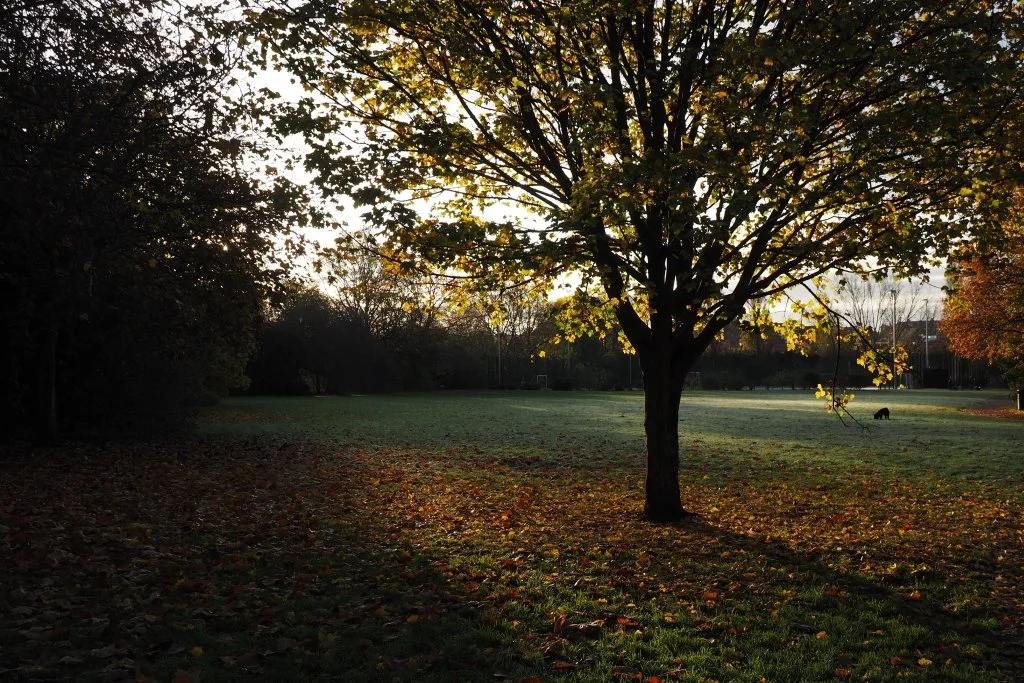
Battersea’s Falcon Park, on a frosty morning last month. All photos © the author.
Here in Battersea most of our public greenspace is looked after by Wandsworth Council; the exception is Clapham Common, where the borough boundary with Lambeth runs right through the middle of the common. So while its western side is actually within Battersea, it's maintained as a single entity by Lambeth Council. Both councils actually did rather well within Good Parks for London 2024 , which came out last month. This well-regarded scheme is run by the charity Parks for London, a strategic body which helps our local authorities share and develop good practice, improve standards and maximise resources. Its reports come out every two years and within them any London borough choosing to participate (25 out of 32, this time) can expect to see its performance measured across the board against PfL's ten criteria (more details in the report, but covering: public satisfaction; quality standards; collaboration; events; health, fitness and wellbeing; supporting nature; community involvement; skills development; sustainability; strategic planning).
Lambeth Council and Clapham Common
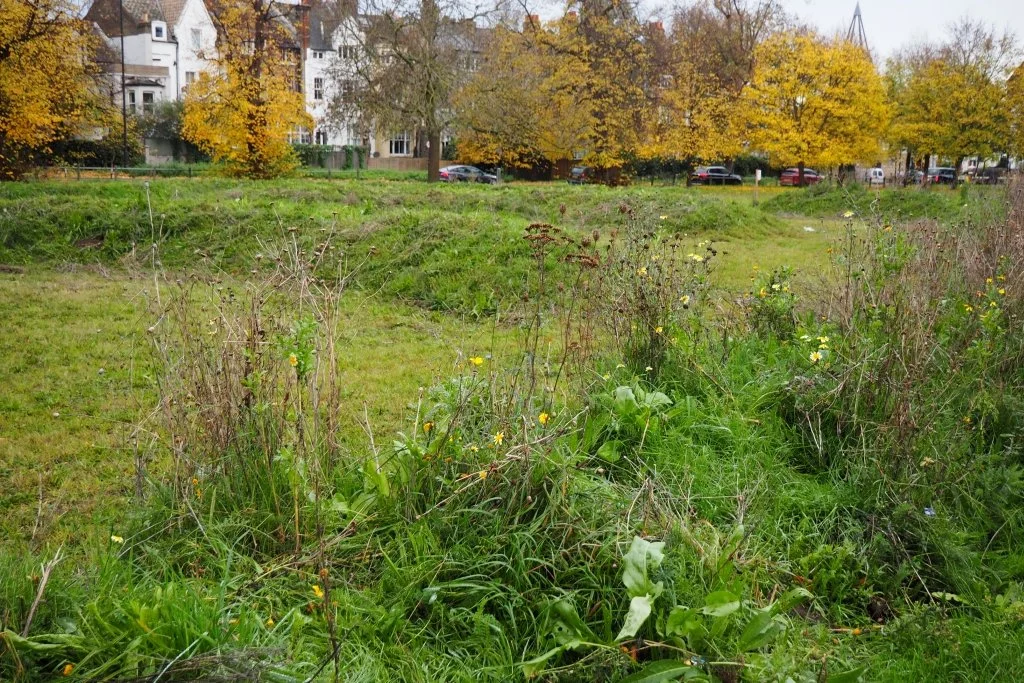
One of the two new wildflower meadows introduced by Lambeth Council on the Battersea side of Clapham Common, partially cut back for the winter.
This year Lambeth Council was delighted to announce that it had come third out of those twenty-five entrants, scoring 52.75 out of a possible 60 points and beaten only by Lewisham (55.5) and Hackney (54.25). While I'm not familiar with its work across the whole of Lambeth, I've felt quite impressed myself of late by what it's been up to Clapham Common. It's scaled down the programme of festivals and other events, and what remains feels better-managed. Permanent facilities are being upgraded: a new water play park beside Holy Trinity Church has proved very popular, and currently a long-derelict but attractive little toilet block beside Battersea Woods is being restored as a café. (Though our committee was less impressed by a recent planning application to convert the sports pavilion beside the disused and neglected bowling green for private educational use.) Still more laudable are the attempts to improve biodiversity across the Common, with the active support of the Common's Management Advisory Committee, its Friends association, and Wild Clapham. The overall management regime has been adjusted to favour nature, with more trees planted and grass-cutting reduced. I've posted previously about the two wildflower meadows introduced on the Battersea side of the Common this year. Now work has just started on a more ambitious project: the creation of a new wetland area over on the Lambeth side, next to Eagle Pond.
Wandsworth’s Open Spaces
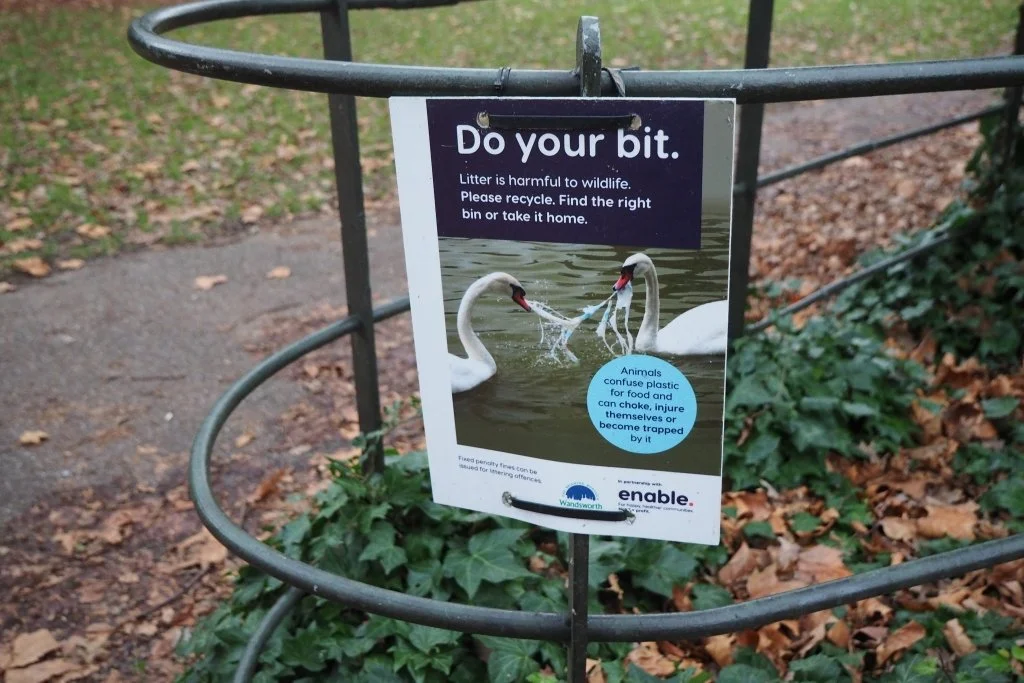
A striking anti-littering sign in Battersea Park, produced by Enable for Wandsworth Council.
Our own council was also pleased to be able to report that it had come eighth in the 2024 Good Parks for London report. (Up thirteen places, from last time.) It's worth pointing out that the current administration wasn't that happy with the park management model it inherited from its predecessors, in which the overall management as well as the day-to-day maintenance of our open spaces had been outsourced, to Enable Leisure & Culture and Continental Landscapes respectively. Both contracts are currently being retweaked, ahead of their renewal early in 2025; the changes to Continental's prioritise sustainability and employee welfare. Those to Enable's are more extensive, and are still being worked on; we welcome the news meanwhile that fourteen strategic roles will be brought back into the Council (that's all six of the Tree Team, two for Biodiversity, two for Parks and three for Sport & Leisure). It's a recognition of their importance, and should encourage joined-up thinking within the Council about prioritising biodiversity, and indeed fulfilling the new Wandsworth Moves Together strategy. But we are also very happy to gather that we can continue to liaise with existing staff on the ground whom we know and greatly value, and who will continue to take the lead on community engagement. And we were also delighted to see Enable's own biodiversity team featured as a case study in the GPfL report, for its citizen science programme monitoring biodiversity on Wandsworth and Tooting Commons.
The Battersea Park Cascades Project
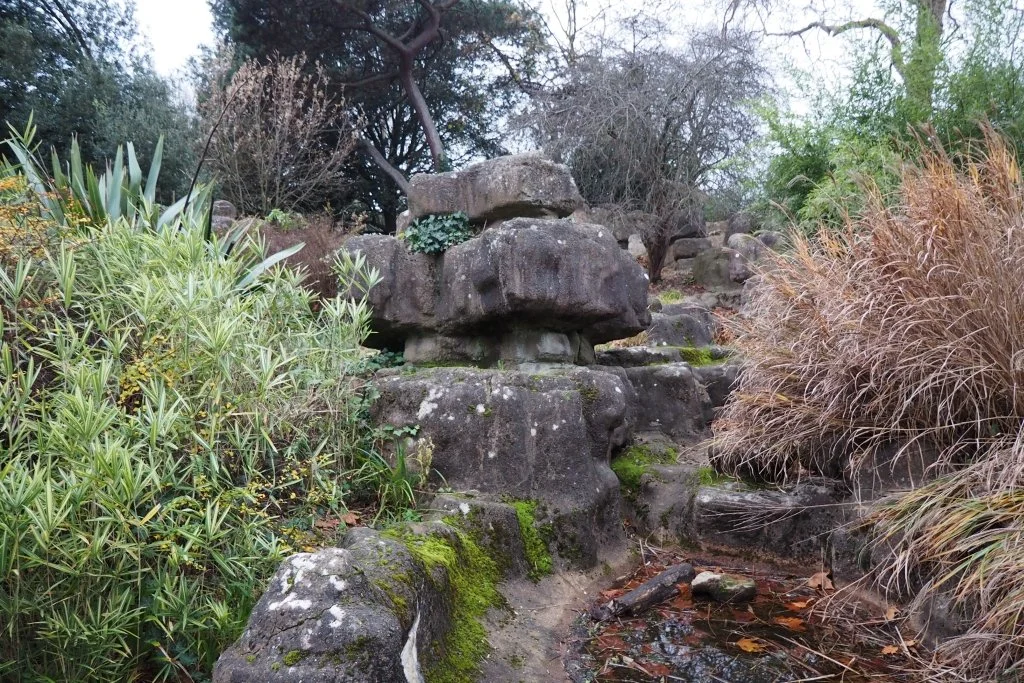
In need of restoration: the Victorian Cascades beside the lake in Battersea Park.
Enable will also continue to lead on the major project to restore the Victorian Cascades in Battersea park, which received Stage I (i.e. development) funding from the National Lottery Heritage Fund earlier this year. A Steering Committee has just been appointed for this, to include representatives from Enable itself, Wandsworth Council, the Friends of Battersea Park, the Battersea Alliance - and myself, on behalf of the Battersea Society. I'm excited to think that we may be able to see this important and picturesque feature of the park back in action before too long, delighted as well to be given this opportunity to contribute to the process. It should be fascinating.