
Garton’s Glucose & the Battersea Smell
By Jeanne Rathbone
In the mid 1960s I was employed in the laboratory of Garton’s Glucose, working on their starch products and testing them for companies such as Bird’s Custard. The company’s origins went back to the mid 19th century.
In 1847, Charles Garton [1823-1892] established Garton, Hill & Co. Ltd in Canute Rd, Southampton. His father William had been a brewer in Bristol. In 1855 the company, using a new technique patented by Charles, began to produce saccharin, a grape sugar (glucose) made from cane sugar, also known as invert sugar. This could be used in brewing, wine-making, distilling and jam-making. Charles’s innovation had taken years to develop and required an investment of £30,000. It revolutionised the brewing industry, enabling brewers to produce much lighter beers, rather than heavy, soporific beers.
Charles’s nephew Richard Charles Garton (1867-1934) was instrumental to the company’s success. Richard was a financier, racehorse owner and breeder. Having studied fermentation issues at Owen’s College, Manchester, and the University of Marburg, Germany, he trialed manufacturing liquid glucose from maize, and became the Governing Director of the company. Knighted in 1908, Sir Richard had stood as the Conservative candidate for Battersea in 1900, but lost to John Burns.
Gartons & Sons relocated their sugar and glucose factory to Battersea’s riverside in the 1880s. It was located next to Price’s Candle Factory, with a road in between them leading to the river, where lighters docked. Garton & Sons specialized in sugars for brewing, invert sugar and ‘saccharum’.
At the same time as Garton’s was consolidating its business, the French entrepreneur Alexander Manbré (1825–1904) set up the Saccharine Co. Ltd in Spitalfields in 1855, where he turned starch into solid glucose sugar. The enterprise relocated to Hammersmith in 1876, a mere two miles away from the Garton’s factory.
In 1926, Garton’s was taken over by the Manbré company, coming under the umbrella name of Manbré & Garton, with Richard Garton as Chair. From this point, glucose production was concentrated at the Battersea site, while cane sugar was processed in Hammersmith. At Battersea, operations expanded, with buildings occupying five acres.
During World War Two, Manbré and Garton developed a new, more rapid method for the production of penicillin in its Battersea factory using corn-steep liquor, and although it was badly damaged by a flying bomb in 1944, the factory was operating again in two days.
The firm continued until 1976, when it was taken over by Tate and Lyle. Charles Henry Garton had been the Chairman of the family firm Garton, Sons & Co. and became a Director of Manbré and Garton Ltd.
A tragic accident at Gartons in 1899
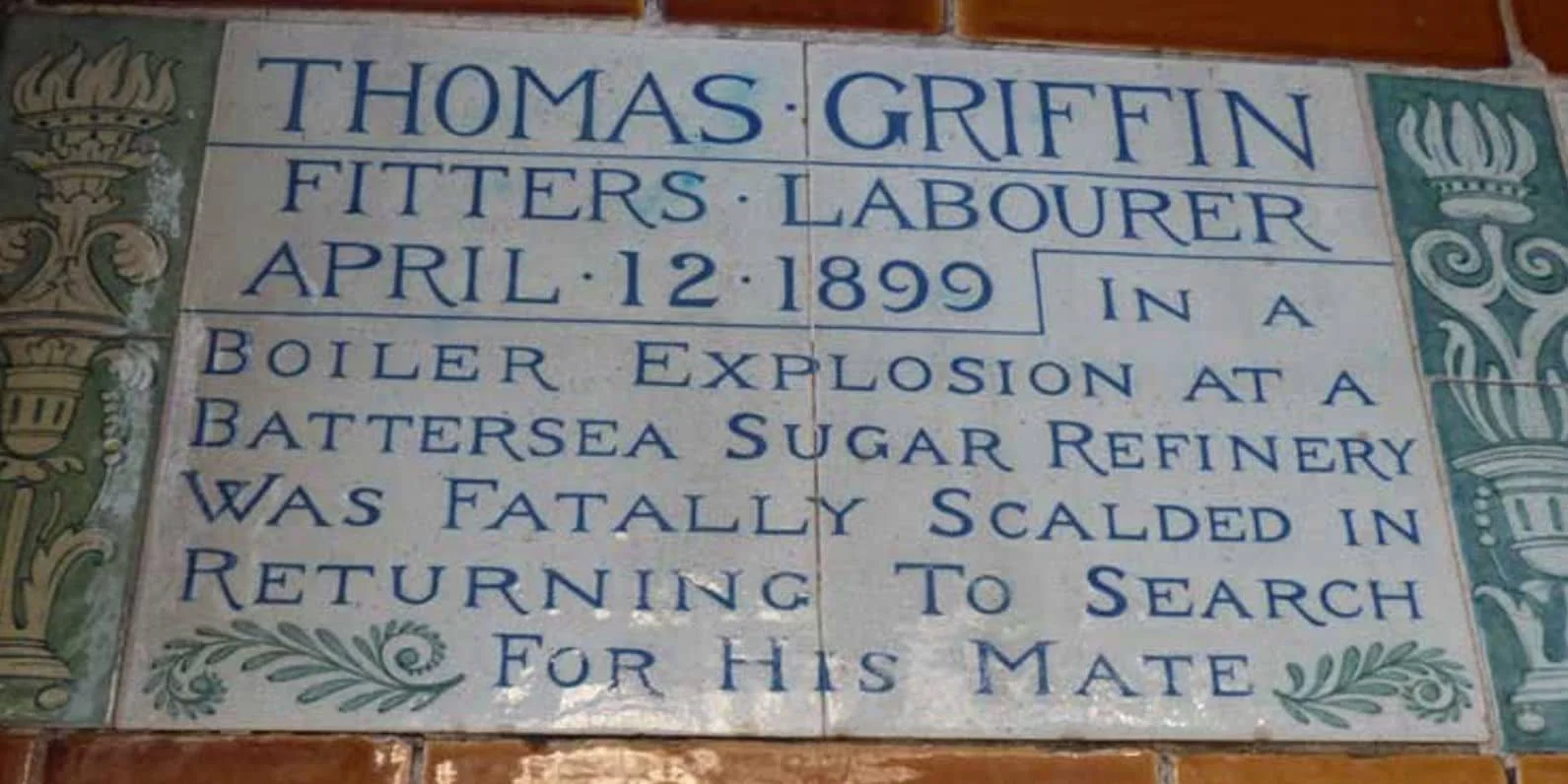
On the 12th of April 1899, a 21-year-old labourer, Thomas Griffin, was fatally injured at Gartons. He was working in the hydraulic room when he heard an explosion nearby, where his colleague Fred Biggs worked. Griffin rushed into the steam shouting ‘my mate, my mate!’. When he emerged a few minutes later, he was badly scalded, and died soon after from his injuries. Tragically, his death was in vain: Biggs had already escaped unhurt. At the inquest into the incident, the Deputy Coroner described it as “a peculiarly sad case”, as Griffin was due to be married the following month. “His employers fully realised the splendid conduct and the high motive which prompted the deceased to act as he did,” the Deputy Coroner said, adding “The conduct of a man like him deserves to be recorded.”
The tragedy was recorded with a memorial tablet on the Watts Memorial to Heroic Self-Sacrifice in Postman’s Park, the brainchild of the artist George Frederic Watts. The Memorial was unveiled in 1900 with just four plaques installed, including the one for Thomas Griffin. There are now 54.
The Battersea Smell
Many will remember the Battersea Smell, a by-product of Garton’s processing. Left-over fibre was piped across the yard, then superheated to make cattle feed. It was this process that created the odour. It was described as a cloying, unpleasant stench that hung over the area for nearly 30 years. Tate & Lyle bought Gartons for £44 million in 1976. The factory had closed by 1980 and most of its buildings were demolished shortly afterwards for the Plantation Wharf development, including Homebase which was later replaced by the Royal Academy of Dance.