
Orlando Jones & Co - Making Starch by the River
Jeanne Rathbone
Battersea’s riverfront stretches from near Wandsworth Bridge to Vauxhall Bridge in Nine Elms. As with many former parishes beside tidal flood plains, the lowest land was reclaimed for agriculture by draining marshland and building culverts for streams. This farmland provided food for the City of London and surrounding populations centres.
Industry in the area was concentrated just outside the borough boundary with Wandsworth, at the confluence of the Thames and Wandle rivers. This area had been settled from the 16th century by Huguenot craftspeople, who established mills, breweries, dyeing and bleaching works, and calico printing. From the 1750s onwards, industries developed eastwards along the banks of the Thames. The river provided water for transport, steam engines and water intensive industrial processes.
Orlando Jones & Company Starch Factory
Orlando Jones & Company was established in 1840 by its namesake, who held the U.S. patent for the process of manufacturing starch from rice or corn. The starch was particularly prized for use in laundering. By 1848 the company was owned by father and son duo William Evill and William Evill Jnr, who relocated the starch factory from Whitechapel to large premises on the riverfront, next to Price’s Candle Factory. The works extended from the river to York Road, enabling goods to be delivered and sent by road or river. William Evill was a member of The Institution of Civil Engineers, and over his long involvement with the company designed, erected and enlarged the extensive works at Battersea.
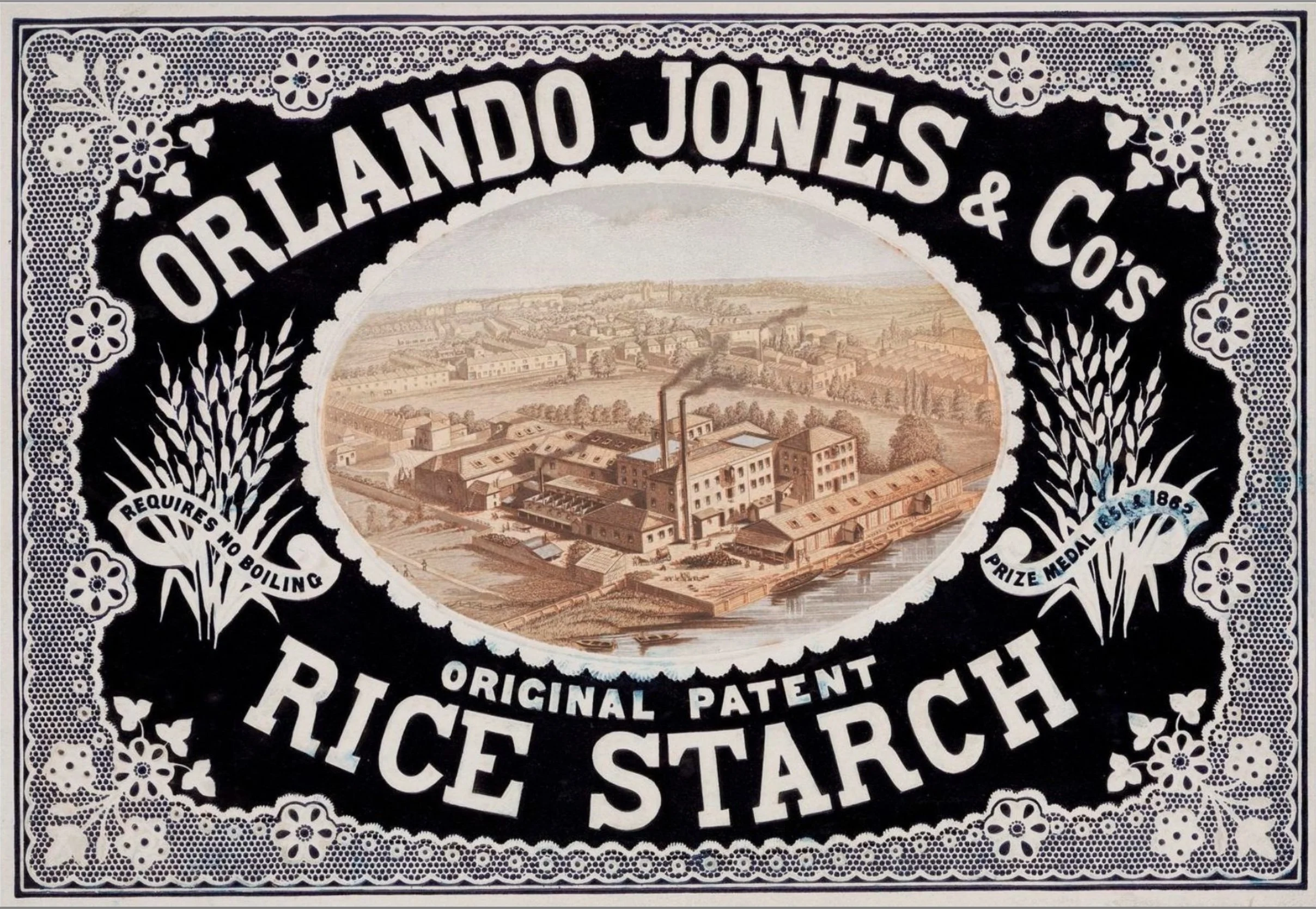
A handbill for Orlando Jones & Co’s rice starch
Henry Simmonds, in All About Battersea, described Orlando Jones’ patented innovative process for manufacturing starch from rice: “[it] consists in the treatment of rice by a caustic alkaline solution during the steeping, grinding and macerating of the grains. The alkali used is either caustic potash and soda, of such a strength as to dissolve the gluten without destroying the starch.” The company also produced wheat flour marketed as Chapman’s Patent Prepared Entire Wheat Flour, which Simmonds described as being “distinguished by its richness in earthly phosphates which are essential to the development of bones and teeth. This farinaceous food for infants, children and invalids is much recommended by the medical faculty.”
The scale of the company’s production warranted its own box making department in the factory, with its products exported to Europe and the British colonies. William Evill retired in 1891. Ten years later, the company was acquired by the mustard manufacturer Colmans, who transferred the business to Norwich.
The Evills’ impact on Battersea extended beyond the manufacture of starch. William Snr became a JP and stood as a Tory candidate for Battersea. William Jnr and his wife Fanny lived in Lyncombe Villa on St John’s Hill near the railway bridge. As their family grew to twelve children, William made additions to Lyncombe House, including a large music room where his musical brood and friends from St John’s College formed an orchestra. He also helped to finance Christ Church School. Lyncombe House stood on part of today’s Peabody Trust Clapham Junction Estate.