
Citizens of Battersea War Memorial
Sally Sellers
A Unique Memorial
The nationwide VE day commemorations this Spring have marked the 80th anniversary of the end of the War in Europe in many ways, including events in Battersea. Tributes have been paid to the bravery and sacrifice of those who fought, and recognition given to those who contributed in other ways to the war effort. No lives were untouched by the war and civilians endured loss, hardship and fear playing their part in the sacrifices made to win the war against Nazism.
Early in 1952 Battersea Borough Council recognised the need to remember its civilian war dead when it commissioned the building of the Citizens of Battersea War Memorial in Christ Church Gardens. The Monument was unveiled on 28th July 1952 and is dedicated to all the people of Battersea who lost their lives the Second World War.
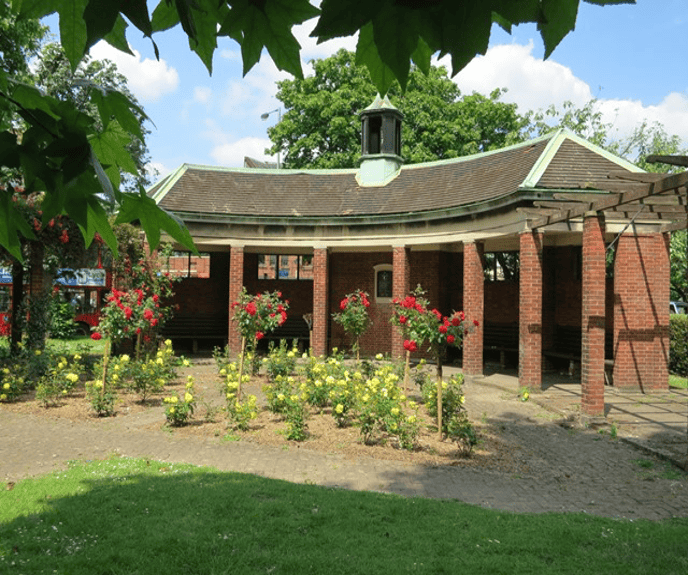
Christchurch Gardens War Memorial
The Bombing of Battersea
The course of the war on the Home Front in London is well documented – after the ‘Phoney War’ came the Blitz and the V1s and V2s – and this pattern was mirrored in Battersea. 280 of its civilian population were lost in the Blitz of 1940-41 and then Battersea suffered badly in the ‘Little Blitz’ of January to March 1944. 3,000 houses were made uninhabitable in a single week in February. Research for the Wandsworth Historian estimated V1s, or ‘doodlebugs’, caused over 200 fatalities in Battersea and although only two V2s landed here they were responsible for 22 deaths and the destruction of the local landmark Christ Church. Sited between Battersea Park and Cabul Roads, today that is the location of the civilian memorial.
A rare Luftwaffe map of bombing targets in the inner south and west boroughs, dated 30th November 1941, was discovered in 2018. The map highlighted key targets in Battersea including the power station, gas works and rail depots as well as industrial sites along the Thames at Battersea Reach. Although in fact these strategic sites suffered less than might have been expected, the impact on Battersea’s housing stock was immense and there were very few streets that remained totally intact. The population of Battersea at the outbreak of war was just under 160,000, by the 1951 census it had reduced by more than a quarter to 117,000. The war had left large swathes of the borough barely habitable with some of its closest knit local communities permanently fractured.
Protected and Preserved
The memorial is in Christchurch Gardens, which was converted from a churchyard to a public garden in 1885. It consists of sheltered public seating providing a contemplative setting for remembrance and reflection. When it was built it stood next to the ruins of the nineteenth century Christ Church destroyed by the V2 rocket. The replacement church, Christ Church and St. Stephen, was built in 1959.
It was in 2015 that the significance of the memorial was recognised by an Historic England listing. The reasons outlined for its designation as a Grade II listed monument were threefold.
Historic interest : as an eloquent witness to the tragic impact of world events on the local community, and the sacrifice it made in the Second World War
Architectural and design interest: as a carefully designed and executed structure, providing public seating for quiet contemplation in a public garden.
Location: being next to the site of a church destroyed by bombing gives the memorial added poignancy.
The crescent-shaped, red brick and open fronted structure has a granite plaque with the inscription “ To the memory of the men. women and children of Battersea who lost their lives in the World War 1939-1945.”
Its setting in a green, garden space creates a fitting atmosphere for people to pay their respects. In 2017 the children of Christ Church Primary School planted hundreds of daffodil bulbs along the line of Battersea Park Road, each representing one of the borough’s lost residents.
In 2018 the memorial was refurbished as part of a £15,000 scheme overseen by the council’s conservation and heritage team. Repairs were carried out to the roof, its timber turret, its copper flashings and leadwork, gutters and rainwater pipes, the memorial’s pergola timber frame and to its paving stones.
Speaking at the time Councillor Cook reflected “I am delighted that this special memorial in Battersea has been protected and preserved for future generations.”
With thanks to Sue Demont whose book ‘The Bombing of Battersea’ was a vital source for this piece.