
London & Provincial Steam Laundry Company
by Hilaire
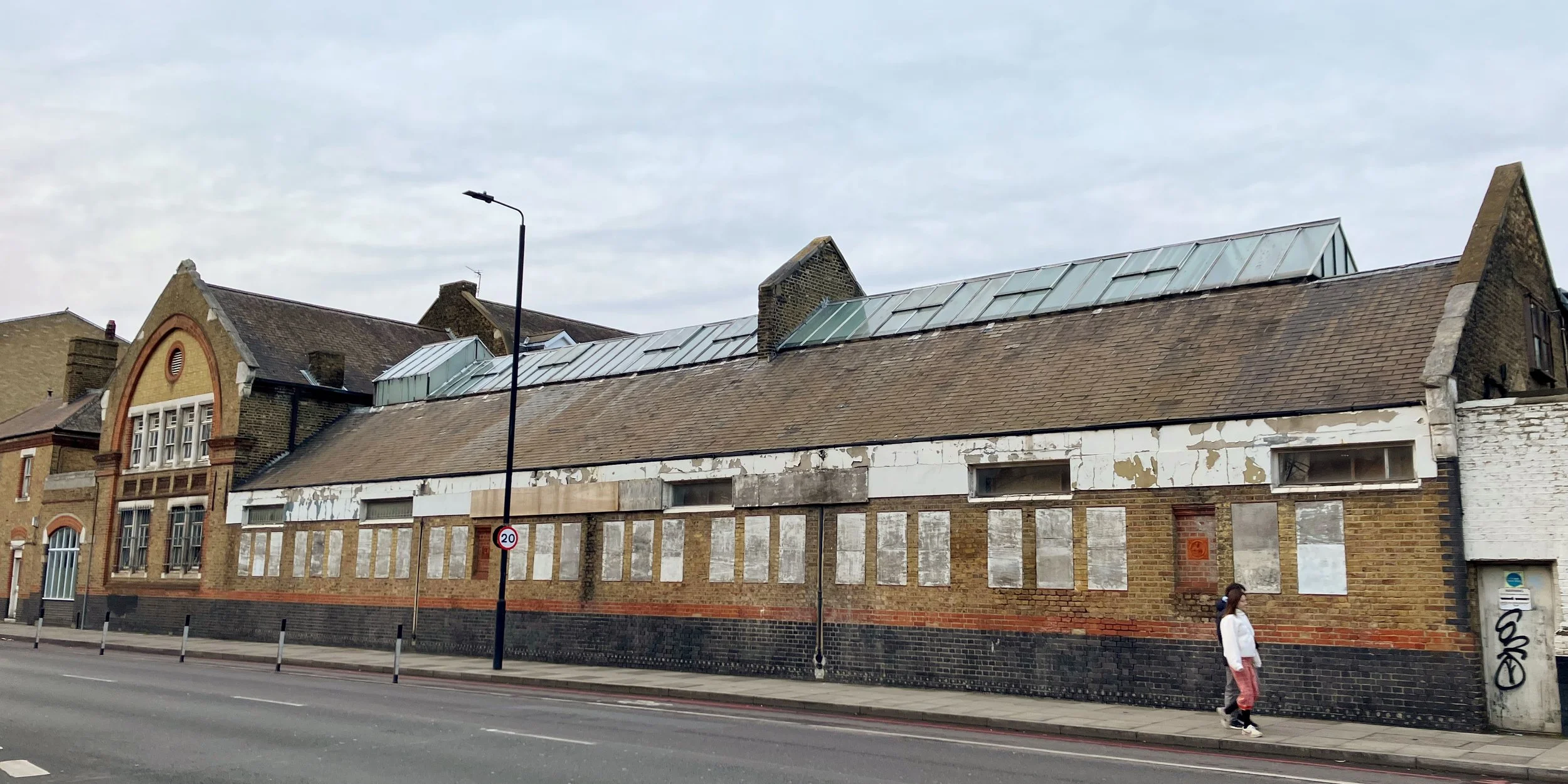
Old Imperial Laundry today
Battersea home to the world’s largest laundry?
Between the late 1870s and 1983 a large commercial laundry operated from premises at 152-154 Battersea Park Road. The London & Provincial Steam Laundry occupied a site of approximately 1 ½ acres, facing onto Battersea Park Road, bordered to the east by Beechmore Road and to the north by Warriner Gardens. Most of the original buildings still stand and now form The Old Imperial Laundry business centre.
The laundry started trading around 1879 and provided employment for local women and girls in an area where most opportunities were deemed suitable only for men due to the heavy labour demands of the work.
An article in the South London Press (SLP) in 1886 provides a detailed account of the laundry’s processes and the impressive scale of their operations. Indeed, it was thought to be the largest laundry of its type in the world at the time it opened. It was certainly profitable as it was the first laundry of its kind to be listed on the London Stock Exchange. Around 180 women and girls and 24 men were employed by the laundry. The manageress and some other company officials lived on the premises, as well as around 30 girls aged from 13 up, mostly orphans, who slept in dormitories at the top of the residential building. The phrase Cleanliness is Next to Godliness was painted on the dormitory walls.
The large main building measured 154 ft by 140 ft, with a skylight running the length of the roof. There were also two smaller buildings for stables and vans, plus a separate block some distance from the other buildings, where infected linen was dealt with away from other laundry. Next to the van shed was an open yard, one acre in size, for drying the laundry, as well as large areas of lawn where linen was bleached.

terracotta relief from original laundry
Reliable process at scale
London and Provincial dealt with both domestic and commercial laundry. The company had a fleet of horse-drawn white vans with blue lettering and scarlet wheels and shafts, and would have been a familiar sight on many London streets. Laundry was collected in lockable baskets, the household retaining a key to what the SLP described as a “rather elaborate padlock”, with a duplicate key held at the laundry. The company dealt with 80-90,000 items per week, yet over the course of a year less than one in 20,000 items was mislaid or lost.
The laundering process was a mix of manual and automated processes, and the first step on a laundry load’s journey was for the contents of the laundry basket to be checked against the list provided by the customer, and any omissions reported back to them. The basket was then passed to one of seven young women to sort the contents and stitch a unique household code onto each item so that at the end of the laundering process it would be returned to the correct household.
The next stop on the laundering journey was the main washhouse, described by the SLP as a “lofty apartment” and measuring 50ft by 30ft. In the centre of the washhouse were two rows of washing machines of different sizes, and articles were manually fed in one at a time through the open mouth of the machine. Washing and boiling troughs stood against one wall, for items requiring that treatment, and at one end of the room “hydros” were installed for spinning washed and rinsed items at 400rpm. Whenever possible, the washed laundry was dried in the open yard. In inclement weather, items were dried indoors on a range of large drying frames, each 12 ft long and 7ft high.
The main building also housed rooms for mangling the washed laundry, and then ironing or calendering items once they had dried. Calendering uses a series of hard pressure rollers used smooth fabric. According to the SLP, the laundry owned “the largest calendering machine ever constructed” with a glosser “capable of manipulating the largest sized tablecloth unfolded.” Dozens of women worked in the large ironing room, where a central stove heated up to 150 irons. Gas irons were also used, and more than 1,500 shirts and 4,000 collars, among other items, passed through the ironing hall each week. Fragile items that were not suitable for ironing were “carefully strained on ingeniously-contrived frames” over rows of steam pipes in a separate room, which the SLP compared to “the hot room of a Turkish bath.”
Laundering on such a large scale required a vast amount of water, all of which was supplied from a 400ft deep well, which had been sunk in the yard at a cost of £600. From this well, the laundry drew around 20,000 gallons of water per day. The depth of the well meant that the water was drawn from the chalk level, and was much softer than water supplied by the main London water companies. The SLP reported that Professor Hehner from the Analytical Sanitary Institute “congratulated [the company] for having obtained such a supply – a splendid one for washing” and described their water as “admirably soft”. While soft water requires far less soap than hard water, the scale of the company’s operations meant it still used 15 tons of soap and 42 tons of starch every year.
Protecting the public
Linen from a household where someone had an infectious disease was considered infected linen and treated entirely separately from the main laundry buildings. This started from the point of collection. There were dedicated vans, lined with zinc, for collecting infected linen. The items were packed in open wirework crates, rather than baskets, and delivered directly to the isolated building. The crates were then loaded bodily into the disinfecting chamber, where the infected linen was treated with dry heat. This was the only truly effective disinfecting treatment available at the time. The whole load remained in the wirework crate for the rest of the cleaning process within the isolated building. The company imposed severe penalties on anyone sending infected items to the laundry without notifying the company. Similarly, any employee who failed to notify management that they may have come into contact with someone with a contagious infection was subject to disciplinary action.
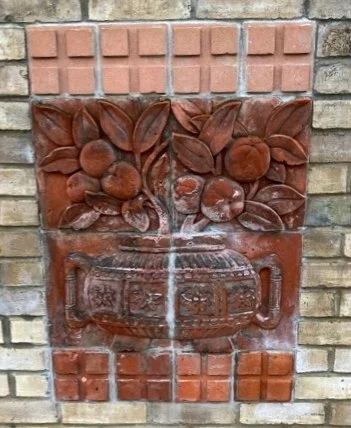
terracotta relief from original laundry
Opportunity for women, but at a cost
Although the laundry provided much needed work for local women, it was hard work with long hours and low pay, and workers could be laid off without pay during slack periods. Unlike the rest of the workforce, who were paid a regular weekly wage, women working in the ironing section were paid on a piecework basis. Employees’ health could also be affected by the heavy work, constant standing and the damp, steamy atmosphere in the laundry. The company’s managing director, Mr J.T. Helby, was a temperance advocate and philanthropist, and unusually established a sick fund for the workforce. Workers paid one, two or threepence weekly, according to their wages, and could then receive medical assistance if unwell. Contributions were refunded when the employee left.
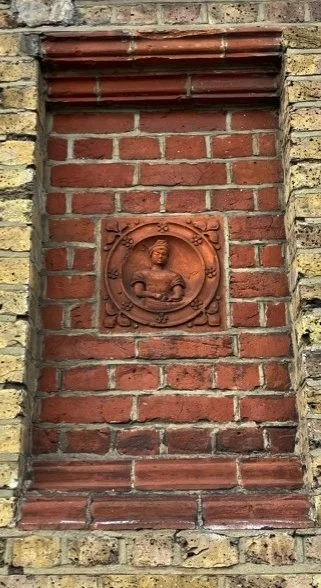
washerwoman terracotta relief
Decline and a new purpose
By the mid-20th century, commercial laundries were gradually losing business as more households acquired washing machines. The arrival of launderettes from the US in the 1950s also impacted commercial laundries. In 1966 the laundry was taken over by the Marie Blanche Laundry Company, and finally closed as a laundry in 1983. The buildings were then converted to a centre for arts and design businesses, and renamed the Old Imperial Laundry.
In 2015, plans were approved to demolish some of the old laundry buildings adjoining Warriner Gardens and to build nine new townhouses. As part of this development, there was a requirement for the terracotta reliefs that decorated the façade of the buildings earmarked for demolition to be retained and re-sited within the development where the public could see them. The development, known as Park Terrace, has now been built, and the terracotta reliefs, depicting a washerwoman, and a pot with peach-like fruit growing in it, have been installed in the low wall by the entrance to each town house. Two reliefs can also be seen on the old laundry wall on Battersea Park Road.