
Emily MacManus, CBE - nursing pioneer
Jeanne Rathbone
I have found another fascinating woman -- Emily Elvira Primrose MacManus CBE, who was born in Battersea 12 April 1886. Her family were Irish from Killeadan House, Kiltimagh, Co. Mayo and she went to live in Pontoon by the lake when she retired as Matron of Guys Hospital in 1946, having served as a nurse in both wars. She died in the hospital in Castlebar Co. Mayo 22 February 1978. Her Battersea beginnings and her wonderful life as a nurse; her service in both wars; and her dedication to nursing all make her worthy of commemoration in Battersea. Like Charlotte Despard, there were two phases of her life and like Despard she retired to Ireland. I was intrigued by her and her Irish family connections.
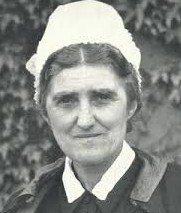
Emily MacManus of Battersea and County Mayo
A Medical Family
Assistance from Emma of the Wandsworth Heritage Service unearthed the census entry of 1911 showing Emma and her family living at 25 Spencer Park in an elegant large house, after her mother Julia was widowed. They had moved from 56 St John’s Hill, formerly the stationmaster’s house that had served as the surgery for her father Dr Leonard Strong MacManus.
Leonard MacManus had been a well-loved doctor and local councillor who had died that year. Her Aunt Caroline was married to Sir Edwin Cooper Perry, Dean of Guy’s Medical School and Superintendent at Guy’s. Her sister Charlotte, who was visiting when the census was taken, is described as a stenographer but she went on to become a radiographer at Guy’s. Her brother Desmond, a medical student in 1911 also worked at Guy’s. The census entry captures the presence of Aunt Lottie, author and committed Irish nationalist, who was visiting from Ireland. Brother Dermot was away training in the military. He later became an active nationalist, at one point a commandant-general in the Free State IRA, as well as an author, publishing two works on Irish fairies and ghosts, and a close friend of WB Yeats.
The family name was variously spelt Mac and Mc. There is a McManus House in the former London County Council estate on Plough Road named after Dr. MacManus. The family were protestant and the funeral of Dr Leonard Strong MacManus was held in St Peter’s Church on Plough Road. The cortege on the route up to St Mary’s Cemetery on Battersea Rise/Bolingbroke Grove was lined with hundreds of mourners.
I am now in contact with the owners of 25 Spencer Park and delighted that they knew about the McManus family and that the house had originally been named Mayo House. Of course, I posed the possibility of a commemorative plaque to Emily and we hope that will come to pass. Her father, so highly regarded in Battersea and Wandsworth should also be commemorated in the plaque.
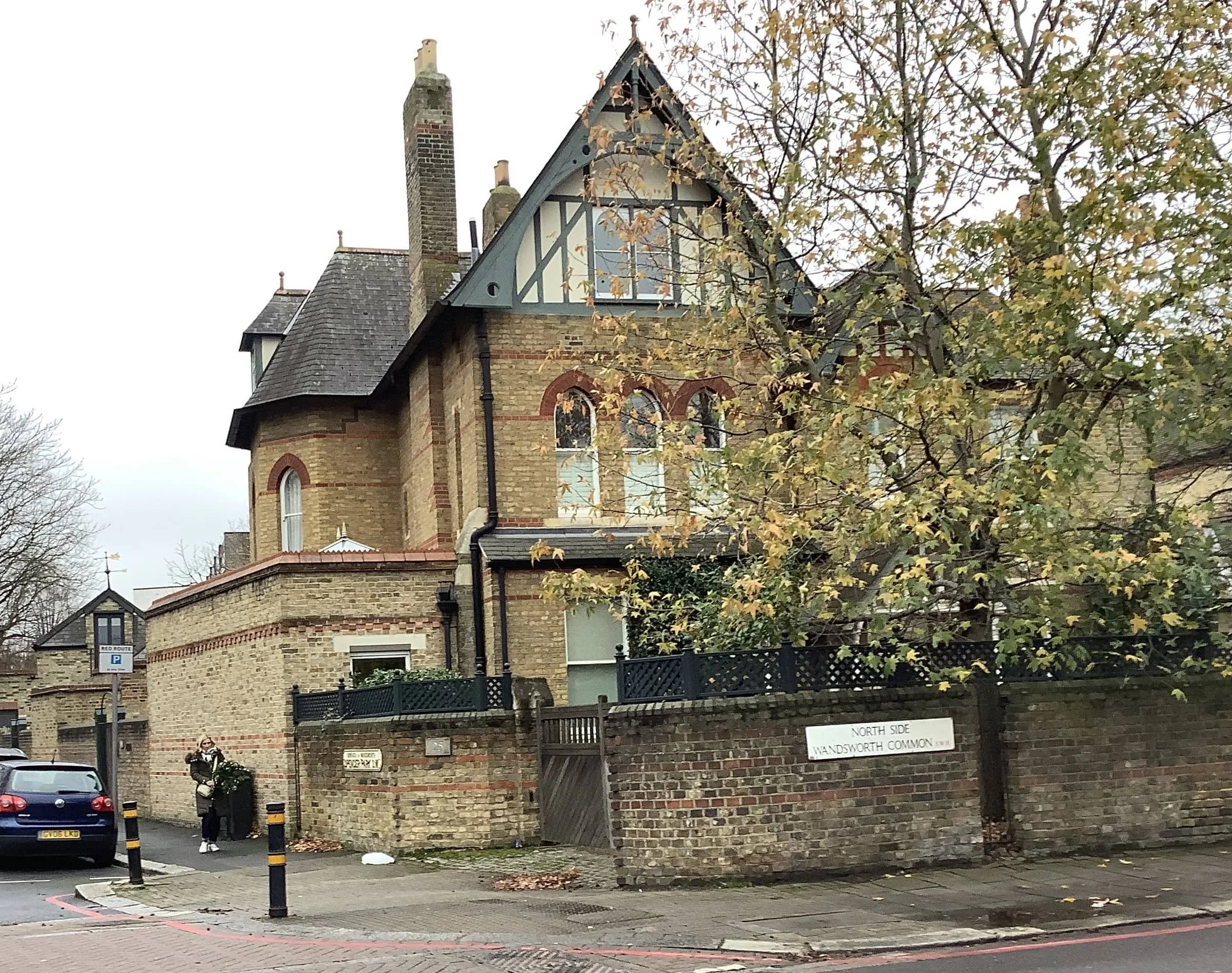
25 Spencer Park
From the Dictionary of Irish Biography
Below is the biography of Emily from The Dictionary of Irish biography, with thanks to Linde Lunney.
https://www.dib.ie/index.php/biography/macmanus-emily-elvira-primrose-a9578
Emily Elvira Primrose MacManus (1886–1978) matron of Guy’s Hospital, London, was born 18 April 1886 in Battersea, the daughter of Leonard Strong MacManus (d. 1911), a doctor, and his wife Julia Emily (née Boyd). Leonard MacManus was from a catholic gentry family with an estate in Co. Mayo. He trained at Dr Steevens’ Hospital in Dublin, and became a much-loved doctor and borough councillor in Battersea, London, but spent as much time as possible at his family home in Mayo at Killeadan House.
He insisted that his two sons and two daughters be brought up to think of themselves as Irish, and wanted them to be country children, rather than Londoners. His sister Charlotte Elizabeth MacManus (1853–1944) was active in the Gaelic League and wrote novels. His wife, Julia MacManus, was a daughter of Robert Macrory Boyd, manager of Jameson’s distillery, and had grown up in Howth House, Co. Dublin. Emily’s cousin Cecil Anderson Boyd (1875–1942) was an Irish rugby international and a doctor who won the MC in 1918 serving in the RAMC.
Emily was the eldest child; she was rather ineptly educated by a governess and in two private schools. As a teenager, she lived for three years as companion to her aunt, Lady Perry (née Caroline MacManus), wife of Sir Edwin Cooper Perry (1856–1938), a surgeon and distinguished medical administrator who was superintendent of Guy’s Hospital (1897–1920). During her time with Lady Perry, Emily learned to drive a steam car, a notoriously difficult machine. Her sister was training to be a radiographer, and a brother became a fashionable doctor in London; Emily decided she wanted a career in nursing. A year young, she successfully got through the interview in Guy’s Hospital, and started a two-months’ trial as a student nurse in Guy’s in May 1908. Nurses’ training at the time was (to modern eyes) almost unbelievably demanding, and life in hospital nurses’ home, such as that at Guy’s, very regimented, but she completed the training and then, from 1912, studied midwifery at the East End Mothers’ Home, a place which would have been an education in itself for most young women of her background. MacManus, however, had already seen many aspects of urban poverty, helping in her father’s practice.
Further valuable experience was gained in a year spent as a sister in a male medical ward in Kasr El Aini Hospital, Cairo, and a short time as a private nurse elsewhere in Egypt. With war threatening, she returned to Europe and worked in Guy’s, training junior nurses, but in 1915 joined up as a Civil Nursing Reserve sister. She worked throughout the war in northern France, helping to establish field hospitals and nursing desperately injured men, especially at Étaples, a vast camp where there could be up to 22,000 patients. Her last posting was in a casualty clearing station at Noyon, just behind the front lines, where conditions were appalling; she was affected by mustard gas emanating from the uniforms of the men she was attending, and had to sleep in bloody and vomit-stained bedding.
War Nurse
In her memoirs Fifty Years of Nursing-Matron of Guy’s (published during 1956 with a preface by her cousin L.A.G. Strong), Emily related anecdotes of the war years and events in France and during The Blitz in London as well as the evacuation of Guy’s Hospital. She told of the responsibility of nurses to create homeliness ‘in the midst of the mud and blood, dust and death, in which they spend most of their days;’ reminded readers of the troops who marched to the battle front only to return as invalids and of the Australian Band Members who perished when their hut got a direct hit. The book included several photographs of France during World War I, with Red Cross ambulances wading through mud, a makeshift operating table with surgeons and rows of invalided soldiers.
Officers & soldiers used ‘lifting‘ as a way of getting round behind the lines in wartime France. But not only officers and soldiers; nurses did it too. Emiy did a lot of lifting on her days off: ‘Another sister and I decided to ‘lorry-hop’ forward, to see one of the recently released French villages that had been in German occupation during the whole war. Luck was with us, for a staff car passed and kindly gave us a lift…. They set us down with good wishes and we took a left hand turn. Soon a lorry came along and we were speeding on the road once more ….’ from the writings of Emily Mc Manus.
Matron of Guy’s
Reminiscences of war experiences published in her autobiography, Matron of Guy’s (1956; 1958), are a valuable record of conditions in army hospitals of the time. She noted that she found it difficult to return to civilian life after the excitement and camaraderie of war and especially missed year-round life under canvas. MacManus, who had transferred to Queen Alexandra’s Imperial Military Nursing Service (Reserve), was twice mentioned in dispatches.
She came back to Guy’s as assistant matron. In 1922 she left to work on a year-long dietary experiment on the boys in the Garden City orphanage established by the charity set up by Dr Thomas John Barnardo and then in 1923 took up the post of matron in Bristol Royal Infirmary. MacManus’s four years there were enlivened by a medical colleague, who asked for her help in treating zoo animals; a baby elephant was cured of boils, and a lion cub survived pneumonia.
Though she was enjoying her time in Bristol, when she was asked in 1927 to apply for the post of matron in Guy’s Hospital, MacManus did not hesitate; the post was perhaps the most challenging and prestigious in British nursing, and her loyalty to the traditions embodied in Guy’s was an important element in her character and attitudes. Guy’s Hospital has immortalized Emily Mc Manus with a dining room and lounge dedicated to her as well as a plaque in their chapel.
Leader in nursing as a profession
As well as running many aspects of the work of a hugely complex institution, responsible over the years for thousands of patients and hundreds of nurses, MacManus was also involved in the politics of her profession, aware of the importance of training and organisation for nurses. For several years she was a member of council of the Royal College of Nursing, which she had helped to found in 1916 (as the College of Nursing), and served as its president (1942–4). She was also a member of the General Nursing Council, a member of council of the Queen’s District Nursing Association (both in the United Kingdom and Ireland), chairman of the voluntary advisory nursing board of HM Prisons (1936–46), and a delegate to international nursing congresses.
After her retirement, she travelled on missions to the British West Indies, Persia (Iran), Turkey and Holland, reporting on nursing services. She published a number of articles in nursing periodicals, and wrote a book, Hospital administration for women (1934; revised second edition, 1949).
Memories of Miss MacManus
I love the description by Tom Rowley from his article in the Women’s Museum of Ireland.
https://www.womensmuseumofireland.ie/exhibits/emily-mcmanus
We knew her simply as ‘Miss MacManus’. She was a small, wiry woman who drifted in and out of our young lives in a variety of amusing, bizarre ways. To us, growing up in Mayo in the 1960s, she was puzzling, at times a bit scary, but most of all ‘different’. The upper-crust accent, the tweed outfits, her little green Morris Minor car all added to her intrigue. It was a bit like having our very own Miss Marple fussing about the backroads of Mayo. And, just like Agatha Christie, it took time to pull all the clues together and discover just what a remarkable person she really was.
Miss MacManus was into her 70s when we got to know her. She lived in Pontoon at Terrybaun in a small lakeside house near my aunt Julia and uncle Ernie. We knew she had ended up matron of a famous hospital in London but I found this a bit boring until I came across a book in my aunt’s house, Matron of Guys by E P MacManus. The photographs were what grabbed my attention: France; World War One; Red Cross ambulances grinding through the mud; rows of bandaged soldiers in a vast tented hospital; surgeons around a makeshift operating table, a young Miss MacManus assisting.
Her modesty and humanity seeps through the pages in her accounts of those years. It was the responsibility of the nurses, she said, to create for the wounded an atmosphere of homeliness in the “midst of the mud and blood, dust and death, in which they spent most of their days”. Her insights are fascinating, sometimes disturbing: An Australian band unit filtered in to fetch and carry, lightening everyone’s spirits. “Then, one night” she wrote, “they were no more – a direct hit on their band hut had finished them all”.
By the war’s end, Miss MacManus was exhausted. She had been a participant in every raw sense in the theatres of two world wars. She longed for Mayo, its peace and healing. In 1946 she retired from Guy’s and in time moved into her lakeside lodge to fish, read and write her memoirs.
In the end she chose to die in Mayo, turning down the offer to end her days in the care of Guy’s. She died in 1978, aged 92, in the Sacred Heart Hospital in Castlebar and is buried in the cemetery adjoining St Michael’s Parish Church in Ardnaree, Ballina. Before her death she had one last request – that locks of her hair be cut off and entwined through the branches of shrubs and trees around Killeaden. So, come spring, birds would use the wisps to build and upholster their nests.
Life by the Lake
When in 1946 she retired from her post in Guy’s and returned to live in Ireland, she had a small house, Terry Lodge, built near Pontoon where she had been spending her holidays since 1933. She gardened, fished, kept bees and goats, and was still to some extent in the public eye. She gave newspaper and radio interviews about her experiences, and was very well known in Mayo. On BBC radio in 1964 she broadcast a series for children, Mary and her Furry Friends. In 1966 she was the castaway on BBC radio’s Desert Island Discs. Her autobiography, Matron of Guy’s, appeared in 1956; there was a reprint that same year, and a second edition in 1958. It is full of interest, attractively written, and illustrated with her own photographs.
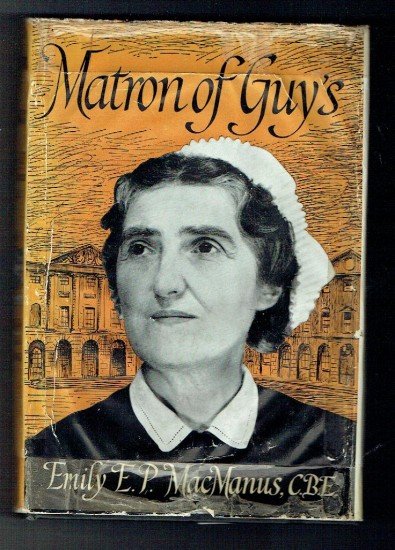
MacManus’s memoir
MacManus was awarded the OBE in 1930 and the CBE in 1947. She had decided to stay in Mayo, even though she could have been looked after in her old age by Guy’s, and she died, unmarried, in the Sacred Heart Hospital in Castlebar on 22 February 1978. She was buried in the graveyard beside St Michael’s church, Ardnaree. An unusual last request recalls her love for the Mayo countryside: she asked that locks of her hair be cut off and entwined in bushes round Killeadan so that birds could use them in lining their nests.
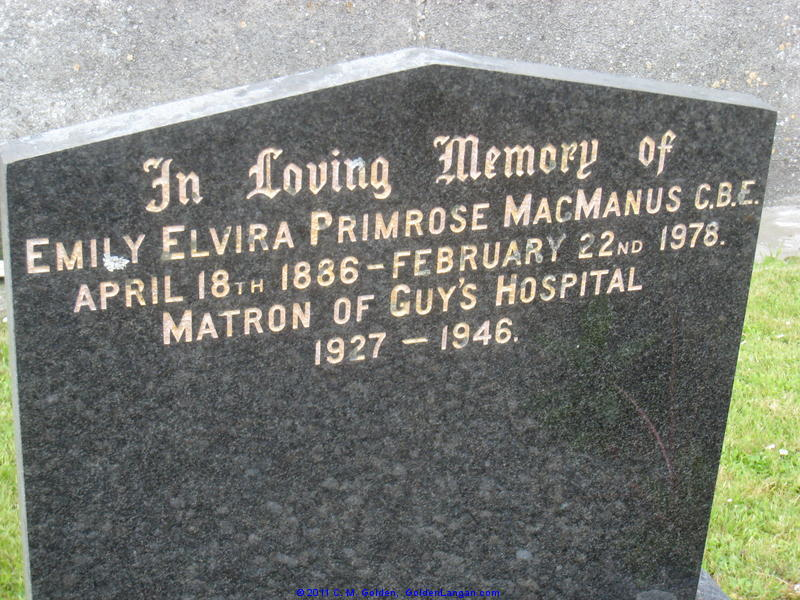
MacManus’s gravestone
There ought to be a plaque
I was so pleased to discover such an interesting Irish woman who is also an Inspiring Woman of Battersea. It was a bonus to discover that her father was a much loved doctor here and I loved learning about her family and their roots in Mayo and Castlebar where I spent many school holidays with my Egan grandparents. So now I need to organise the installing of another Battersea Society plaque, this one honouring both father and daughter.