
The Maskelyne family and Battersea
By Elaine Michel - Battersea Society Trustee and Chair of the Heritage Committee
Readers familiar with north Battersea may already know Maskelyne Close, one of the of roads forming part of the Ethelburga Estate. When I first moved to the area, my father commented on the road name and its association with the Maskelyne family who were famous magicians. All these years later I decided it was high time to investigate, and what a story it is!
It begins in 1839 in Cheltenham, with the birth of John Nevil Maskelyne. In the 1860s Maskelyne, described in the 2013 English Heritage London Review as “a watchmaker turned stage magician who specialised in exposing fraudulent spiritualists and card sharpers,” was performing regularly with his friend George Cooke, touring various venues until a permanent residency at the Egyptian Hall in Piccadilly in the 1870s. The act remained there until the hall’s demolition in 1905. Cooke died in 1904, his role taken over by Maskelyne’s son, Nevil. They relocated to St George’s Hall in Langham Place.
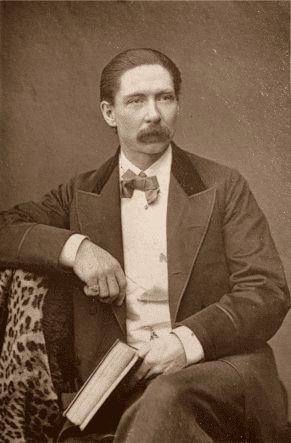
John Nevil Maskelyne
Maskelyne’s son Nevil was born in 1868, also in Cheltenham, and would have been 8 years old when the family moved into the completed house in Battersea. In 1888 he married Ada Ardley in St Mary’s Church, Battersea. They had five children, four of whom would also become stage magicians.
Meanwhile, in 1875 Maskelyne commissioned “two large houses known as Nevil House and Nevil Villa […] on the south corner of Ethelburga Street” which intersected with Albert Bridge Road. Like many other surrounding buildings, it is long since gone, having been badly damaged by bombing raids during WW2. The temporary prefabs which replaced them were in turn replaced by the Ethelburga Estate in the 1960s. Today, Jagger House is on the site of the former House and Villa, and Maskelyne is remembered through the naming of the one of the Estate’s roads after him. Maskelyne was also an author and inventor, one of his inventions being the famous penny coin lock for public toilets.
First Public Hack
Maskelyne’s son Nevil was born in 1868, also in Cheltenham, and would have been 8 years old when the family moved into the completed house in Battersea. In 1888 he married Ada Ardley in St Mary’s Church, Battersea. They had five children, four of whom would also become stage magicians. Nevil’s life was equally as interesting as his father’s: a magician inventor like his father, he is credited with history’s first public hack. In June 1903, Marconi was due to demonstrate his ‘ground-breaking’ long-range wireless transmitter by sending a message securely over 200 miles from Cornwall to London. Maskelyne had been tasked by The Eastern Telegraph Company to prove the transmission was not as secure as Marconi claimed. Maskelyne successfully accessed the frequency Marconi was using and the excited audience at the Royal Institute was treated to the word ‘rats’ repeated over and over again and then a poem, of which the opening lines were “here was a young fellow of Italy, who diddled the public quite prettily”!
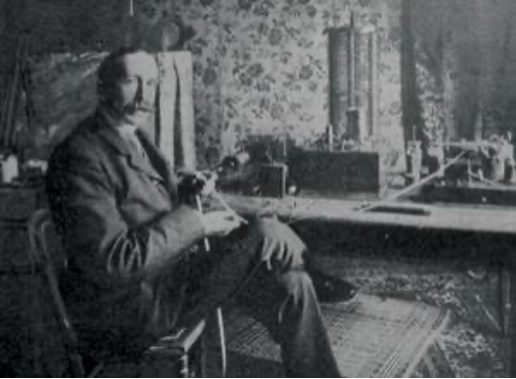
Nevil Maskelyne
He was a founding member of the Magic Circle, and in 1906 was elected President. After his father died in 1917, Nevil assumed control of Maskelyne Ltd until he died in 1924. He was buried in Wandsworth Cemetery.
Third Generation
And so on to the third generation of Maskelynes. As already mentioned, of Nevil’s five children, four went on to be performers at St George’s Hall, developing new tricks and publishing books: Clive, who took over after his father’s death both running the hall and as President of the Magic Circle (1924-1928), Noel, and the youngest, Mary and Jasper, twins born in Wandsworth in 1902. Jasper is probably the best known. According to the Sandhurst Trust, he was commissioned into the Royal Engineers in October 1940 and went to Farnham Castle to complete camouflage training. In his book Magic, Top Secret published in 1949, he claimed the training was boring as it was teaching him nothing new, given he’d grown up performing illusions. That said, according to some former colleagues, he tended to exaggerate his capabilities and was apparently ‘better at magic tricks than camouflage.’ For a while he worked for MI9 in Cairo, developing escape compasses, maps and dummy tanks and vehicles, and had a brief stint as Head of Camouflage before being transferred to ‘welfare’ – entertaining troops with magic tricks. The Sandhurst Trust has kindly given permission to publish this photo of him entertaining a small audience in Egypt. At the end of the war, Jasper was demobbed as a Major, but felt his contribution to the war effort was never properly appreciated. He migrated to Kenya where he ran the Nairobi National Theatre and then a driving school. He died in Nairobi on 15th March 1973.
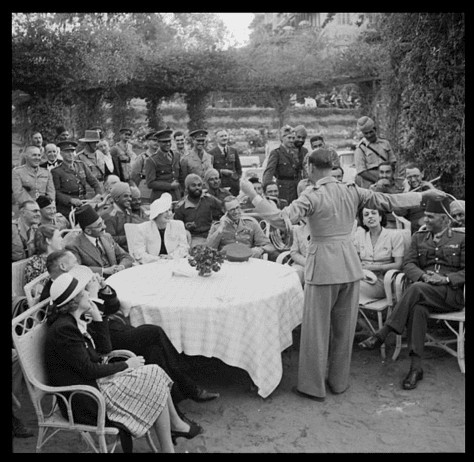
Jasper Maskelyne entertaining troops in Egypt
Photo: the Sandhurst Trust. Used by permission
A lasting legacy of the Maskelyne family, apart from a local street name, is The Magic Circle’s Maskelyne Award, which recognises services to British magic. Amongst past winners are names many will recognise - David Nixon, Paul Daniels, Wayne Dobson, David Berglas, Dynamo and Andy Nyman. The trophy is a sculpture of John Nevil Maskelyne, “the founding father of a magical family who amazed audiences in London for over 60 years.”
For more information see:
https://www.ucl.ac.uk/bartlett/sites/bartlett/files/50.03_around_battersea_park.pdf
https://www.magicians-scrapbook.co.uk/maskelyne-and-cooke-house-of-mysteries/
https://www.ucl.ac.uk/bartlett/sites/bartlett/files/50.03_around_battersea_park.pdf
https://www.londonpicturearchive.org.uk/view-item?i=53314&WINID=1771176457998
https://www.rigb.org/explore-science/explore/blog/historys-first-public-hack-rats-rats-rats
https://www.patrickwreed.com/blog/bunkum-amp-bullsht-the-magical-maskelynes
https://en.wikipedia.org/wiki/The_Magic_Circle_(organisation)
https://themagiccircle.co.uk/about/competitions-and-awards/the-maskelyne-awards/