
What’s in a street name: Part 2 South Battersea
By Sally Sellers
Some time ago we looked at the derivation of street names around Nine Elms, this time the focus is on the area around Clapham Junction. Once again the names provide fascinating insights into the area’s past.
Standing outside the old Arding and Hobbs building near Clapham Junction Station it’s hard to miss the name St. John - with St. John’s Hill leading up towards Wandsworth and St. John’s Road along through the shops. Directly opposite, on a plaque outside the Falcon pub, is an explanation for the prominence of the name in the area.
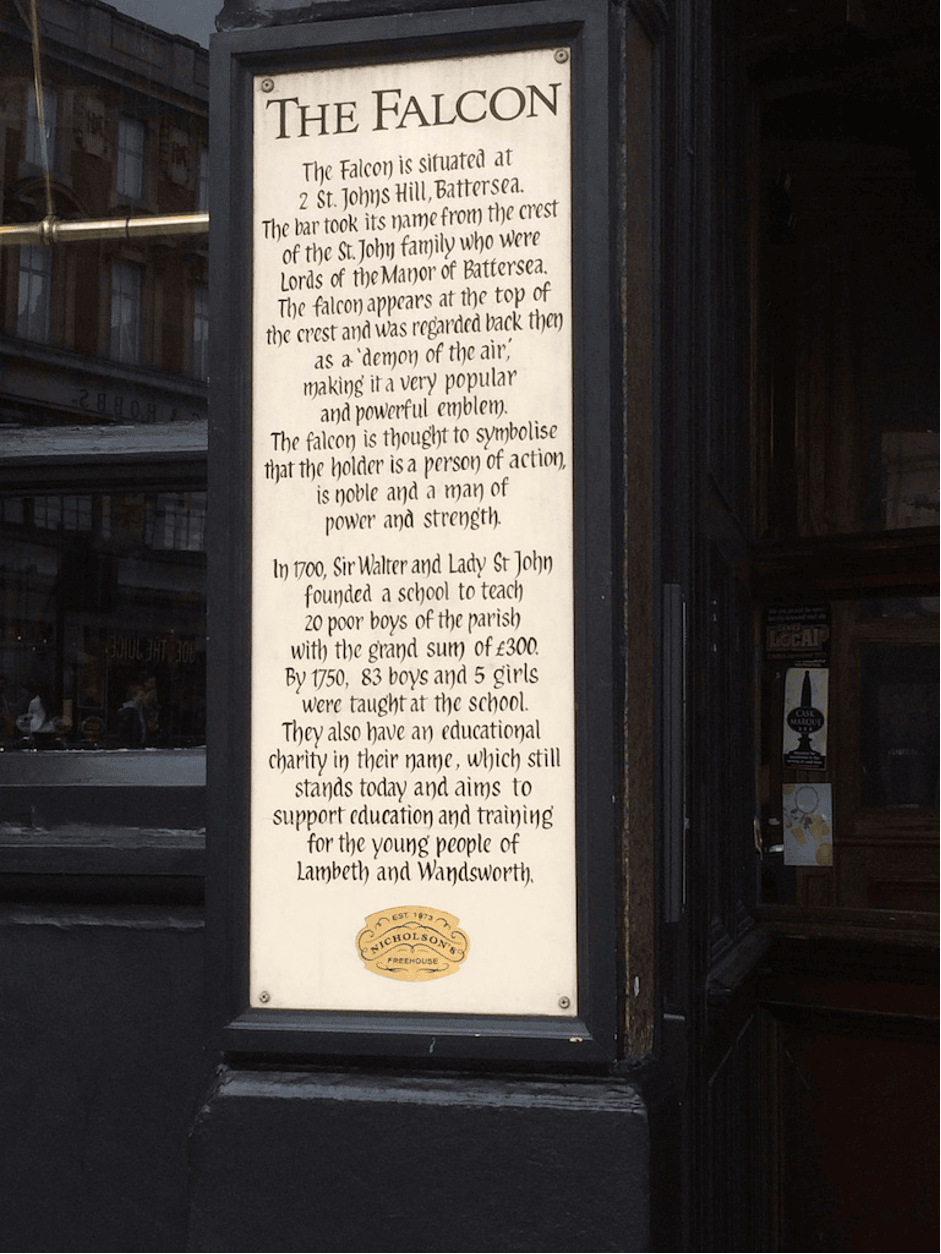
In 1627 Oliver St John purchased the ‘manor of Batrichsey with Wandsworth’ and the family remained Lords of the Manor of Battersea until it was sold to Earl Spencer in 1763. This Oliver St John was a favourite of King James 1 and had been made Viscount Grandison of Limerick in 1623.
The St John family built and lived at Battersea Manor House situated on the banks of the Thames next to the parish church, below which lie the family vaults. (The house no longer exists but the current St Mary’s Church, opened in 1777, is on its original site.) Walter St John, Lord of the Manor from 1656 -1708, and his wife Joanna showed genuine concern for the welfare of their Battersea parishioners, distributing alms to the poor, building alms houses and in 1660 founding a school on Battersea High Street for 20 poor boys.
Photo: Plaque explaining origin of The Falcon’s name
The names Spencer and Grandison, highlighted in the section above, show there are two other roads whose names can be associated with the St John family and a further one is Bolingbroke Grove.
The title Bolingbroke is long connected to King Henry IV, but in 1712 Henry St John , grandson of Walter, chose the title Viscount Bolingbroke when he was raised to the peerage by Queen Anne.
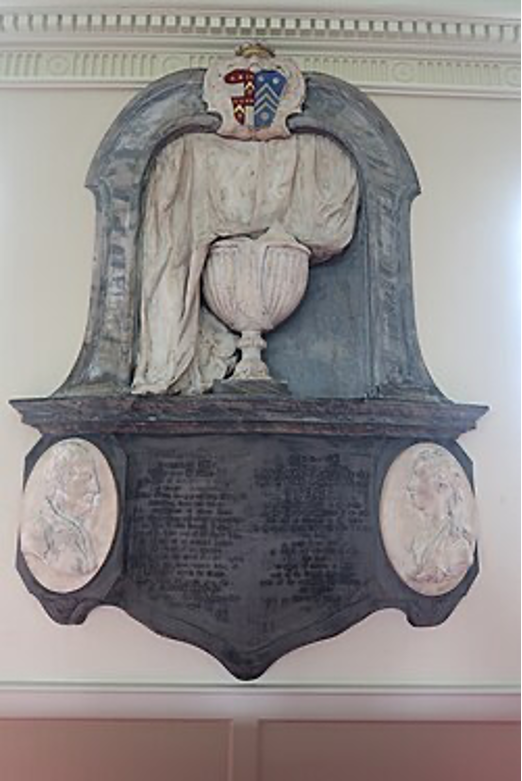
Renowned as a Tory politician, statesman and philosopher as well as a treacherous libertine, Viscount Bolingbroke was christened at St Mary’s Church and is buried there. A monument with medallions and inscriptions composed by Bolingbroke himself was erected to their memory.
But Bolingbroke Grove was not always known by that name. At one time it was known as ‘The Five Houses’, a name most likely deriving from the number of substantial houses that fronted on to the lane most notably Bolingbroke House and The Elms.
Photo: Bolingbroke Memorial in St Mary’s Church
It is hard to establish the reason for the name of Northcote Road, which appears to derive from the prominent 19th century Conservative politician Stafford Henry Northcote. The road lies over a culverted stream, the Falconbrook. The plaque on the Falcon pub connects the name to the crest of the St John family, so Falcon Road could be named for both. Further down Falcon Road is the Falconbrook pub, this was previously ‘The Asparagus’ a name which also connected it to Battersea’s past. Asparagus, sold in ‘Battersea Bundles’, was grown in the market gardens which lined the riverfront before industrialisation and the railways.
Another crop grown successfully in Battersea was lavender, explaining the names of Lavender Hill and Sweep.
Finally, Boutflower Road, opposite St. Marks Church on Battersea Rise, was chosen to commemorate Henry Boutflower Verdon the first vicar-designate of that church who died young in 1879.
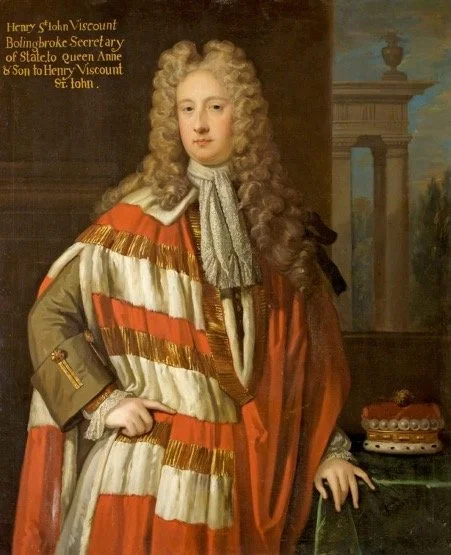
Portrait of Henry St.John, 1st Viscount Bolingbroke (1678 – 1751), in peers robes. The Drawing Room, Lydiard House